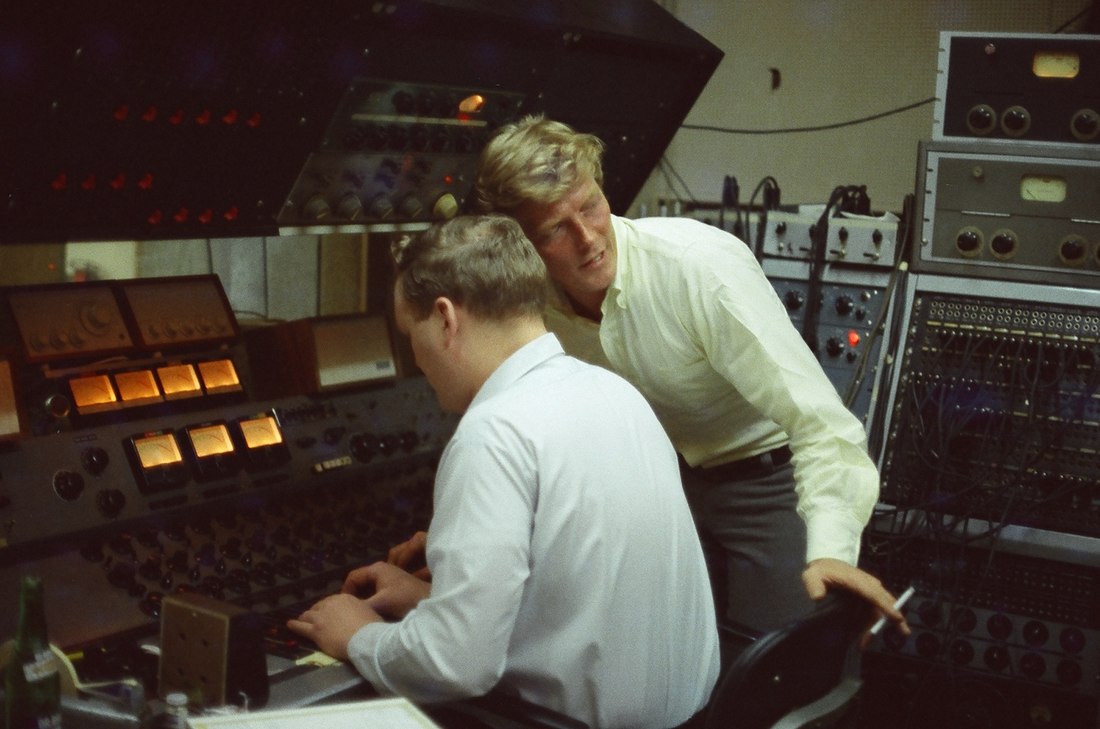
A technical analysis of the recording techniques and technology of the 1960s and the limitations this has placed on the surviving versions of the songs we grew up with and still love. It brings us to the latest ‘Anthology’ box set and points to a new way for current and future generations if someone spends the money on an engineer who ‘feels’ the sound and can capture it’s true glory
This is a series of quite technical articles regarding sound engineering principles and standards based on research of the 1960s recordings of Frankie Valli and the Four Seasons and their context with the sound engineering technology of the day and the possibilities in 2026. It examines where the surviving recordings sit today compared with the emergence of AI and the abilities in sound engineering that could never have been imagined when they were recorded back in the 1960s. It’s history is partly informed by interviews with Sound Engineer George Schowerer [from 1966 to 1968 at Mirasound Studios in NYC] and AI .
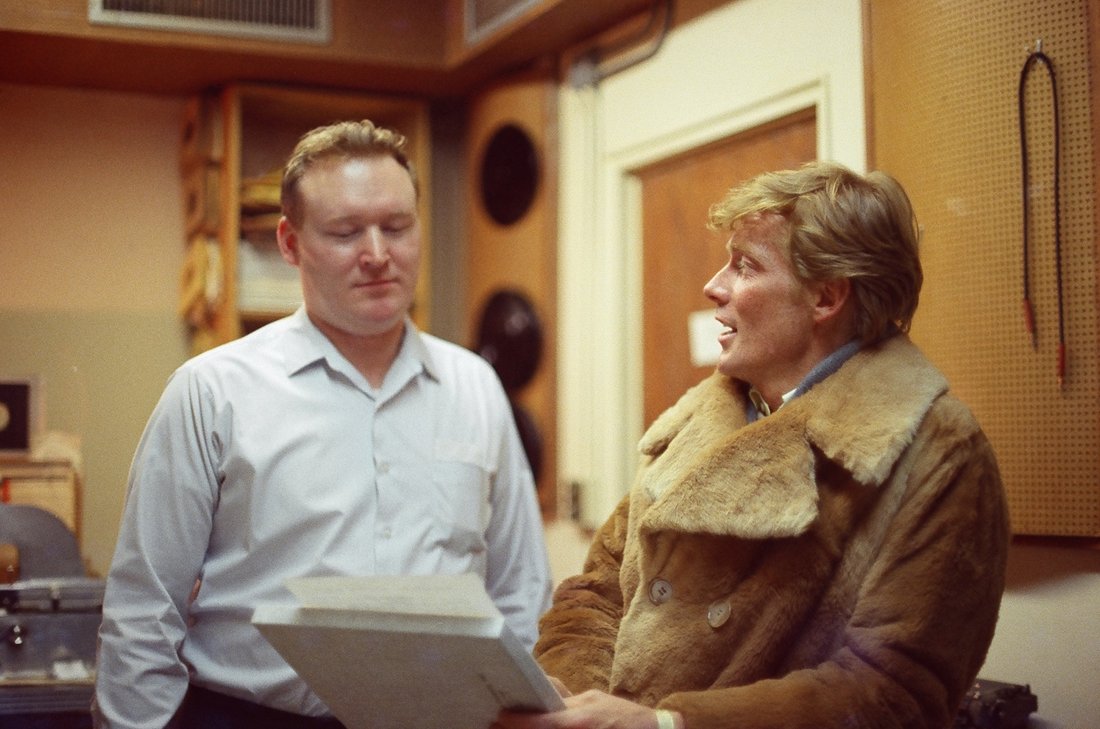
The aim is to illustrate how getting the sound Bob Crewe, Charles Calello and the Fours Seasons put on to tape and mastered to the best quality is still an aim of sound engineer fans like me with today’s AI technology. AI extraction and re-mastering is the latest and greatest breakthrough in recording restoration since the start of the ‘digital era’ in the 1980s. Unlike groups like the Beach Boys and The Beatles no-one has done any in depth story [such as Phd Papers] re elements that make up the Four Seasons music such as song structure, rhythmic feels, instrumentation, chord progressions, lyrical themes, and vocals as they developed ‘That Four Seasons Sound’ through the three distinct periods of musical, personal and collective growth with quality writers and producers during the 1960s and 70s.
I have tracked the story of the known and quoted changes in my now complete e-book – ‘The Rise and Fall of the NEW Four Seasons’ and my recent project ‘I’m Gonna Change’ was a way of ensuring that some properly mixed STEREO versions of their changing sound are available via You Tube which will become evident as I review this with Sound Engineer – George Schowerer’s recollections of the studios and how the sound quality we have on CD today was created. It builds on some of the research of surviving analogue tapes during the Snapper Music Box Set and the subsequent DIGITAL ARCHIVE I have assembled for the Historical Society[a library of the best surviving mixes….an extended ‘Anthology’]
Jane Simone O’Regan 2014 in her Phd thesis on the Beach Boys attempted to define… .”What is a “Sound”? Music is typically described in terms of its “sound”; record companies use the term to market albums, journalists use it to compare music in reviews, musicians use it to explain their work and listeners use it to discuss music. This idea of “sound” links together fundamental musical elements such as structure, harmony, melody, tonality and rhythmic feels. Additionally, it also links together specific musical equipment, instrument types, effects and production techniques that also contribute to creating a distinctive sound. Beyond the physicality of the music, more intangible, socio-cultural elements may also affect a particular sound, such as the time and place in which the music is made, and the historical backgrounds of the writers and performers. All of these elements – the music itself, the production that is used and the time, place and history of those who create it – contribute to a particular sound. “
This is not a socio-cultural analysis of the Four Seasons ‘sound’ or career or the changing membership of the group, but of the recording environment that they worked in and the surviving sound sources that will carry forward to future generations. It is a focus on the technical creation of all of the above in the Frankie Valli and the Four Seasons catalogue of music during the days of 2,3,4,8 and 16 track analogue tape recordings during the 1960s. Their music created from 1962 to today was predominantly archived on Magnetic Tape [up until 1985], and the only reference source anyone has had access to for the past decades of the Digital[CD]Era has been the Four Seasons Partnership[FSP] storage of Safety Copies. Rhino have the rights to issue and have their own set of Masters, which is worthy of further research. There may be more to be found about sources and the ‘unreleased’ in my continuing blog.
This access to the FSP Master Tapes was partially researched for the Snapper Music Box Set and will be considered in these articles. The current status for me is that ‘best sources’ of their ‘sound’ are not on many of the currently surviving Analogue Tapes[or in this latest Box Set] – and that has become clear for one period. The sources for the early to mid 60s tracks we now know of, have inherent problems which today are still not fully addressed with proper research of tape sources and digital transfers over the past 35 years by the FSP or any Record Company.
Magnetic Tape deteriorates over time and the transfer and re-mastering for the Snapper Music Box Set shows this deficiency . Rhino Records [including Curb] may have better transfers from the 1990s [with Bill Inglot’s tape research and transfers from tapes stored for 35 years less] and Bob Gaudio may have a quality set of masters in other ‘home’ storage but ‘The Digital Library’ I have compiled is ‘maybe’ the definitive sound quality reference collection until ‘whenever’? . No-one has researched CD sources over the past 3 decades in such a way as I have from a big library of the album releases on CD.
The Evolution of Sound Engineering
But first here is an introduction and a summary/overview of the history of music recording courtesy of several internet sources.[apologies in you know all of this?] Some conflicting dates have been raised in Forum Groups over the years but I have used best endeavours to reflect accuracy as far as possible. This data is from five and a half decades ago and both paper records and peoples memories may be flawed!!
The beginning of course was Thomas Edison by trying to create a device that could be used to record dictation for business purposes, not for recording music. Later (late 1880's) the Edison company came out with a wax cylinder recording device. About the same time they came up with a way to mass produce pre-recorded wax cylinders and that started the recorded music business as we know it. Wax was fragile and later flat resin and plastic based disks were invented and recordings cut grooves into the disks which were later duplicated into what became known as ‘records’. Several other recording formats were invented in the early 20th Century included wire recorders, which recorded magnetic pulses on steel wire. There were also huge steel tape recorders which were used by the BBC. If the steel tape got loose it could cut someone to shreds. These 2 formats were not very good and most recording studios still cut records on flat disks until the later 1940's when modern tape recording was invented.
Magnetic tape is a medium for magnetic storage made of a thin, magnetizable coating on a long, narrow strip of plastic film . It was developed in Germany in 1928, based on the earlier magnetic wire recordings from Denmark. Devices that use magnetic tape can with relative ease record and play back audio, visual, and binary computer data. I first recorded on a reel to reel tape recorder in 1961. Magnetic tape revolutionized sound recording and reproduction and broadcasting from the 1950s on. It allowed radio, which had always been broadcast live, to be recorded for later or repeated airing.
The Germans invented modern recording in 1935 with the invention of the Magnetophone which used a revolutionary AC Bias system which produced very high quality recordings of propaganda speeches and music which still [amazingly] sound clear today. Modern recording condenser microphones were also invented in the same era in Germany by a guy named George Neumann.
The history of modern multitrack audio recording using magnetic tape had really begun in 1943 with the invention of stereo tape recording, which divided the recording head into two tracks. In 1948, Chicago's Armour Research Foundation announced that its staffer, physicist Marvin Camras, had produced a three-channel machine with "three parallel magnetic tracks on the same tape". However, stereo sound recording of two separate audio sound streams to two speakers from tape had been perfected in 1943 by German audio engineers working for the AEG corporation. Around 250 stereo tape recordings were made during this period (of which only three have survived), but the technology remained a closely guarded secret within Germany until the end of World War II. The big breakthrough for the music and radio companies was that when World War II ended, a guy named Jack Mullin took some of the high quality German tape recorders to America and the American company Ampex ripped off the German technology and started mass producing professional tape recorders. Mullin and the Ampex corporation pioneered the commercial development of tape recording in the US, and the technology was rapidly taken up by radio and the music industry due to its superior sound fidelity and because tape – being a linear recording medium – could be easily edited, by physically cutting and splicing the tape, to remove unwanted elements and create a 'perfect' recording. Two-track tape recording was rapidly adopted for modern music in the early 1950s because it enabled signals from two or more separate microphones to be recorded simultaneously, enabling both twin-track mono recordings (with the voices on one and music on the other) as well as true stereophonic recordings to be made and edited conveniently, which in turn facilitated the rapid expansion of the consumer high-fidelity ("HiFi") market. Stereo (either true binaural two-microphone stereo or multi-mixed) quickly became the norm for commercial classical recordings and radio broadcasts, although many pop music and jazz recordings continued to be issued in mono sound until the late 1960s.
The major development in multitrack recording had come in the mid-1950s, when the Ampex corporation devised the concept of 8-track recording, using its " Sel-Sync " (Selective Synchronous) recording system, and sold the first such machine to musician Les Paul . The American had the idea that you could record multiple tracks one at a time on tape and Ampex build him a custom 8 track machine [and the 1 inch Tape] which is now owned by the Smithsonian. The process involved using the record head as playback head so you could hear what was recorded on one track while you recorded on another. The tracks were then ‘mixed-down’ to a single [MONO] track
Eventually multi-track recording on tape was standard. First 2 track, then 3, 4, 8, 16 and finally 24 by the early 1970s. Notably Bob Crewe recorded Frankie Valli on 24 tracks at Motown in 1973 and those tracks still remain in the Motown Archive – UNRELEASED. New mixing boards had to be developed to handle all this. Eventually companies started making these boards, people like Rupert Neve (Neve), Bill Putman (Urei - Universal Audio) and API
Despite Ampex having created the first eight-track tape machines for Les Paul and Atlantic Records, multitrack recording was taken up in a more limited way in the industry first via the standard three-track recorders. These proved extremely useful for popular music during the early 1960s, since they enabled backing music to be recorded on two tracks (either to allow the overdubbing of separate parts, or to create a full stereo backing track) while the third track was reserved for the lead vocalist. Three-track recorders remained in widespread commercial use until the mid-1960s and many famous pop recordings – including many of Phil Spector’s's so-called "Wall of Sound" productions and early Motown hits – were taped on 3-track recorders.
A great many of those utilized multiple 3-track sources with the basic band being recorded on the first three, that being mixed down to mono and "flown over" to a second 3-track, leaving two open. The process was repeated for sidemen, soloists, background singers and any number of other elements before the last track on the last recording stage was used for the lead vocal.
The next evolution was four-track recording, which was the studio standard through the mid 1960s. Many of the most famous recordings by The Beatles and The Rolling Stones were recorded on four-track, and the engineers at London's Abbey Road Studios became particularly adept at the technique called "reduction mixes" in the UK and "bouncing down" in the United States, described in the paragraph above. In this way, it was possible to record literally dozens of separate tracks and combine them into finished recordings of great complexity. There were limitations, however, because of the build-up of noise during the bouncing-down process, and the Abbey Road engineers are still justly famed for the ability to create dense multitrack recordings while keeping background noise to a minimum.
In the 70's-80's people began to experiment with digital recording. Digital audio tape (DAT) was introduced, offering a digital alternative to analog tape in the 1980s. Analog-to-digital converters (ADCs) were used to convert analog audio or video signals into digital formats, often within transfer devices or computer sound cards. The huge breakthrough came in the early 90's with the invention of the Alesis ADAT digital recorder. Others followed. Finally popular computer based recording became standard using software such as ‘Pro Tools’. That approach to transfer music off surviving tapes for all artists has been managed through the last 4 decades to create the digital libraries we have today and to replace deteriorating tape sources. This article extract taken from ‘Sound On Sound’ is an essential background to this background to what follows.
Individual Studio Multi-track recordings have in most cases not survived from the 1960s and only STEREO/MONO Safety Copy Tapes still exist of the Four Seasons tracks….we are told. Although a good deal of The Beatles and Beach Boys catalogues have survived on Multi-tracks, we believe from an interview with Bob Gaudio in 2002 and confirmation by Bill Inglot during the Snapper Research that very little of Valli and the groups efforts on multi-track exist pre 1971. The status however of the Philips/Mercury storage is something I am going to re-visit in future blogs. The failure by the FSP to recognise the value of past master tapes and the knowledge of the fanbase to recognise variations in released tracks or discovered acetates and to find nearly lost ‘only on vinyl’ masters was partly reduced by my work on the Snapper Music Box Set. The article above shows the difficulties of salvaging the sounds from the studios as stored on the technology of the day.
A detailed history of Sound Recording is available on Wikepedia and in published Articles
Recording With Bob Crewe and The Four Seasons
Although the Bob Crewe productions of The Four Seasons were done on 3 and 4 track consoles during the first half of the 1960s, this was to enable the multi-track creation of instruments and vocals which were all mixed to MONO for release. Their Record Company issues of so called ‘STEREO’ albums was confined to unbalanced channels that engineers pulled together with huge separation in many cases. Pseudo [Fake]Stereo using processing tricks was done in several cases to fool the listeners ears. This is apparent on the many STEREO re-issues from the analogue Safety Copies tapes transferred to digital storage during the 1980s and 90s. At Vee-Jay the ‘Studio Masters’ [known as ‘The Delivery Tapes’] are surviving mainly high quality STEREO mixes as research during the Snapper Music Box Set revealed. Although STEREO and MONO Safety Copies [not multi-track] the Frequency Response and Dynamic Range is excellent. These should have been used in the Box Set but clearly were not. These masters were transferred to the group and Philips in August 1966 as the company went bankrupt. The original 3 and 4 track recordings are we believe lost, but we do not know for sure, or how this happened
Below is an example of the original transfer of the first volume of tapes supplied as part of the Vee-Jay ‘Delivery Tapes’ and the fact that Bill Inglot ‘reconstructed’ the ‘Sherry and 11 Others’ from these tapes for the 1988 release on CD shows my point. The fact was that the best masters in STEREO were there shows them as the ‘reference’ versions.
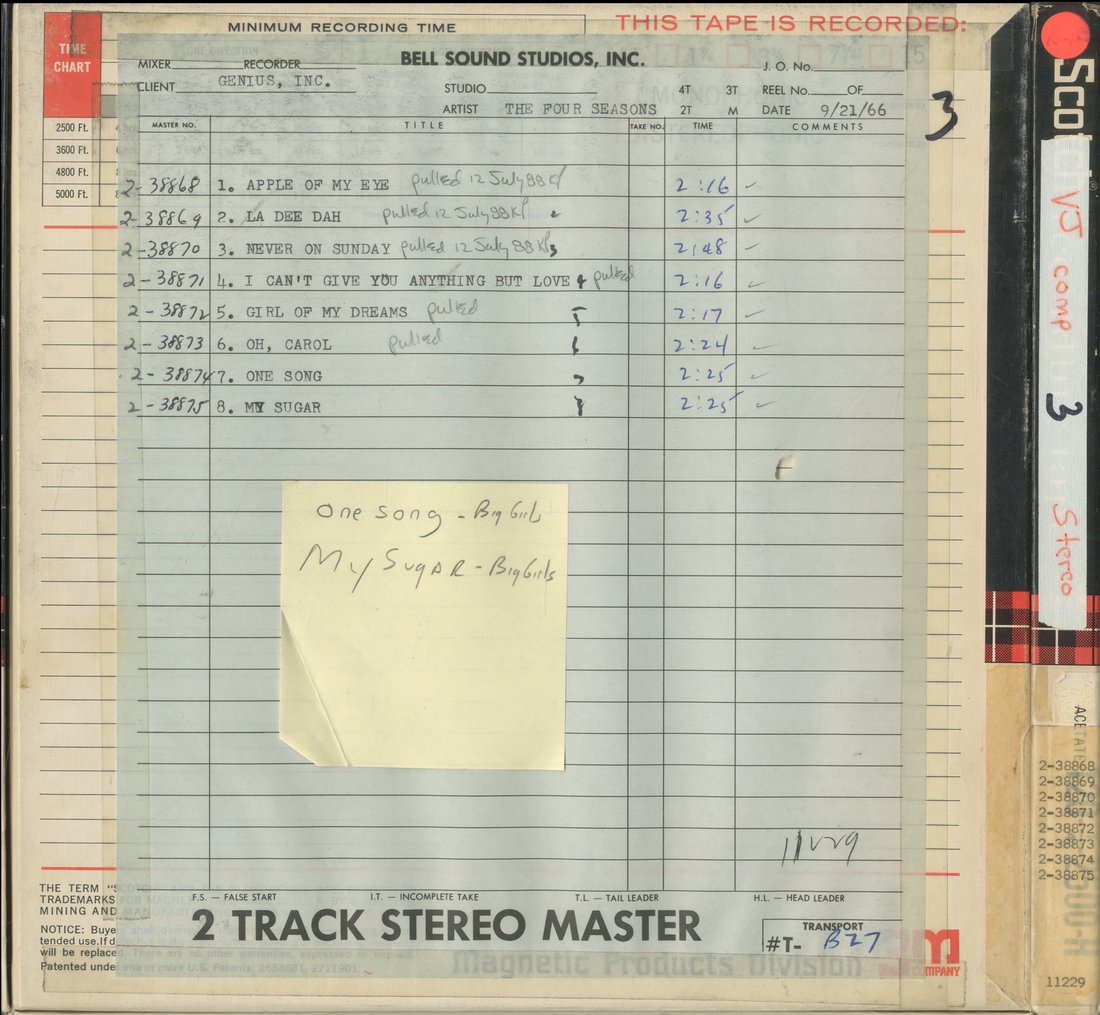
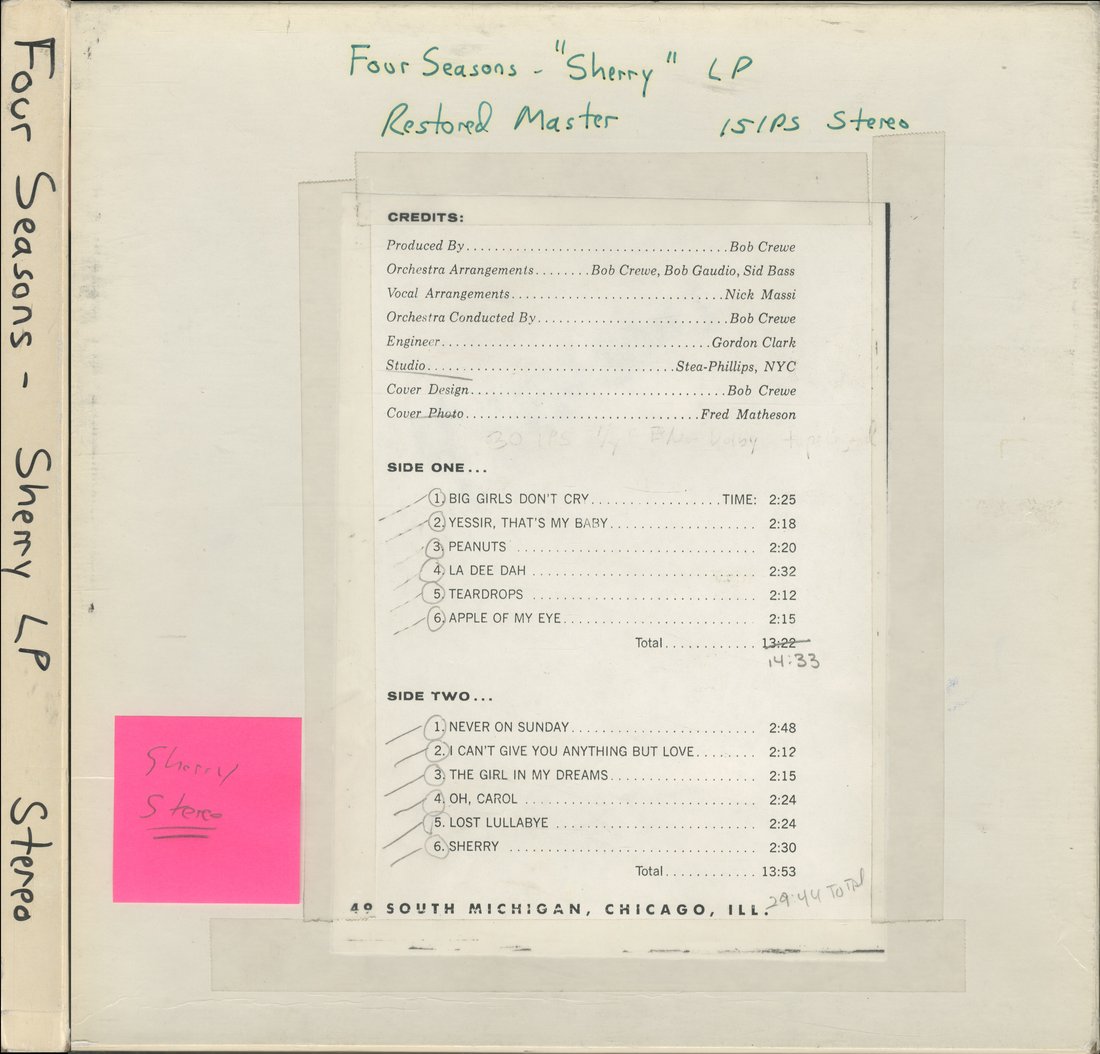
The surviving Tapes from the Philips period have however clearly deteriorated in the FSP storage as shown in the Box Set issue results. The sound engineers who worked on the Mastering during this early to mid 60s period were Gordon Clark and Bill McMeekin.
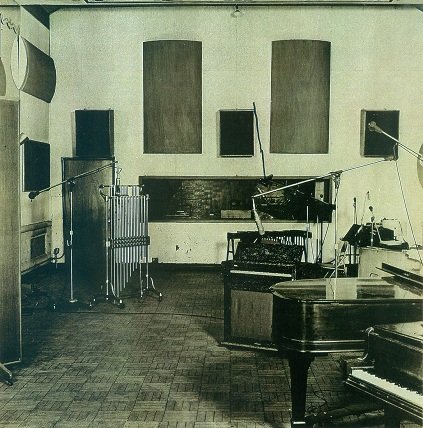
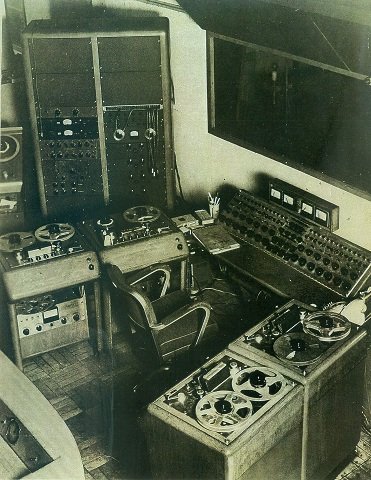
As Charles Calello confirmed….. ’the intention was always MONO’ .
Back when George Schowerer started working as a Sound Engineer with Bob Crewe he was working at Allegro Studios in 1958 pre the creation of The Four Seasons.
“ Now in my earlier days with Bob Crewe(59-61) done at Allegro studios featuring Freddie Cannon, Billie & Lillie, the Rays, and the Shepard Sisters, we had only two mono Ampex recorders which were used. You can imagine how much bouncing was done this way! Other sessions at Allegro (not for Bob),were ‘He's so Fine’ ( The Chiffons) and Mickey and Sylvia/Kitty, The Tokens, etc. Most of those sessions used only two Ampex four channel mixers combined to a mono output…….not until 61/62 did we get into stereo at Allegro. Following that period I was drafted into the US army till Jan 64, I was not active in the studios. When Bob found that I had returned, we connected again at Mirasound in 66/67……..and the rest is history.”
But not every studio back in the late 50s and early 60s had 2, 3 or 4 track recording. The second Ampex model 5258 eight-track was sold to Atlantic Records [ at Tom Dowd 's insistence in late 1957. Atlantic was the first actual record company to use a multitrack [as opposed to stereo or three-track] recorder in their studio in 1958. Both Motown and Columbia (in LA) started to bring 8-track online in late 1964.
The Four Seasons famously recorded two songs only on the Atlantic 8 track consoles with Tom Dowd at Atlantic Studios in November 1963. The songs were ‘Dawn’ and ‘No Surfin’ Today’ [as far as we know – Charlie Calello thinks ‘Cry Myself To Sleep’ may also have been recorded there and maybe others that appear on the ‘Born To Wonder’ album?] and the Master Tapes were collected by Bob Crewe on the day JFK was assassinated according to the paper records. But then Bob and the group [for monetary reasons] signed to Philips and moved back to 4-track recording of sessions through 1964 and 1965 [some at Stea-Philips and others at Olmstead studios] until excess distortion on the ‘Working My Way Back To You’ album [according to Charl ie Calello] persuaded them to move to Mirasound Studios in NYC and 8 track consoles in 1966. There is no record of the engineer or studio on The Four Seasons 1966/67 recordings but ‘Opus 17’ and the Frankie Valli ‘solo’ tracks completed after leaving Stea-Philips/Olmstead studios at the start of 1966 were arranged by Herb Bernstein after Charlie Calello’s departure to Columbia Records. There are a number of Safety Copy Masters missing from the 1965/66 period in the FSP storage that have been replaced by vinyl dubbed 45s to achieve a complete catalogue of released tracks in the Snapper Music Box Set released in 2023. The studio sources are unclear and clearly no tapes were acquired by the Partnership at the time or are they in the Philips/Mercury storage or lost at Bell Sound [more re that later].
By comparison and as a matter of interest other groups namely The Beach Boys[Brian Wilson] and The Beatles were experimenting extensively by the mid sixties and many of their tapes have survived to benefit fans today as releases in the 21st century in ‘anthology’ box set has shown. Because The Beatles did not gain access to eight-track recorders until 1968, their groundbreaking Sgt Pepper's Lonely Hearts Club Band LP (1967) was created using pairs of four-track machines; the group also used vari-speed (also called pitch shift ) to achieve unique sounds, and they were the first group in the world to use an important offshoot of multitrack recording, the Automatic Double Tracking (ADT) system invented by Abbey Road staff engineer Ken Townsend in 1966. Motown too very much wanted an eight-track, so they were building one. It turned out to be fall, 1964 before the machine was installed. So Atlantic and Motown were the two majors Studios with eight track by 1964.
In 1967, Ampex built its first prototype 16-track professional audio recorder at the request of Mirasound Studios in New York City. This unique machine was the first of its type and used reels of 2-inch (51 mm) tape on a modified tape transport system originally built for video recording. The album ‘Everything Playing’ by The Lovin Spoonful as one of the first examples using this console, was recorded on 16-track at Mirasound and released in December 1967.
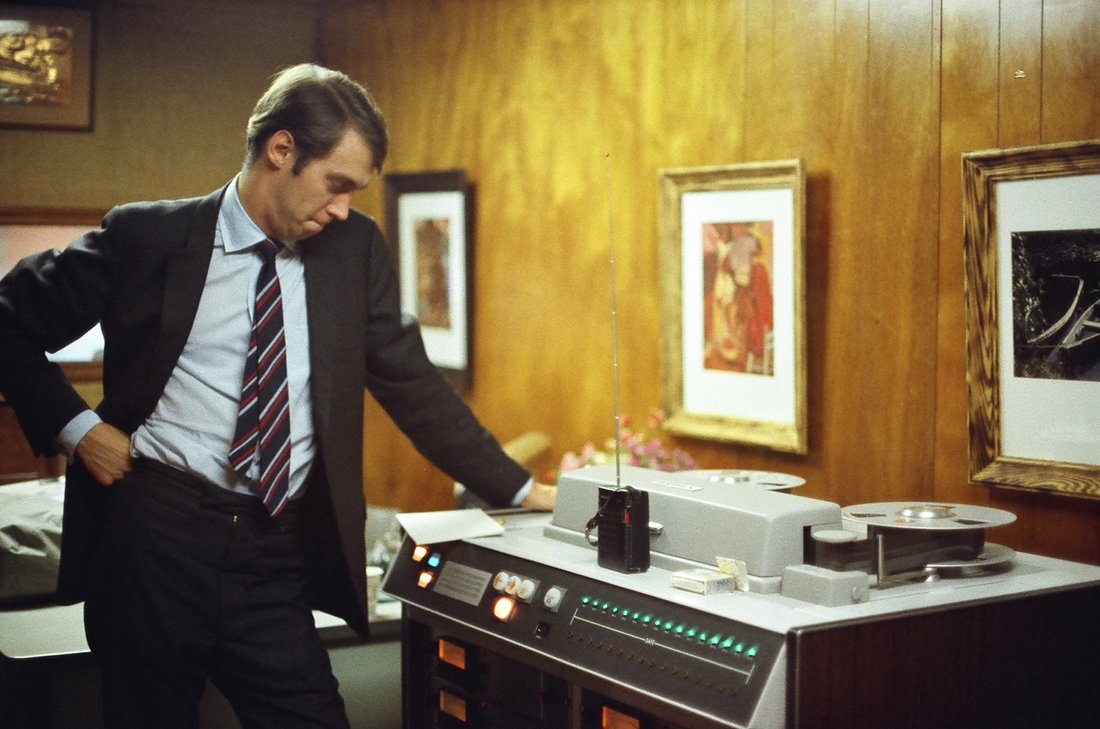
Having moved there in 1966 Frankie Valli and The Four Seasons were then able to take advantage of the additional elements to add to their mixes during 1967 and the clarity of surviving masters demonstrate this from digital transfers made from surviving tapes from this period. More on this as I explore past research by Sound Engineers George Schowerer and the late Stefan Wriedt in Part 2.
Past Four Seasons Sessions and Masters
The Four Seasons Partnership[FSP] have always maintained that they own their Masters, but after four years of research for the Snapper Music Box Set the truth is their catalogue is a mess. Yes it has to be said. Despite years of re-issues on CD there is still no comprehensive record of what they recorded and no satisfactory collection of the mono and stereo tracks for the pre 1968 recordings for us to play…and still dozens of unreleased supposedly unsatisfactory tracks in the vaults. What Rhino have and how they were recovered remains a story to be told by Bill Inglot and them.
In the ‘Both Sides Now’ sound forum several years ago TallPaul[Paul Urbahns] said of the catalogue.. “Bill Inglot has stated the Partnership does not have a mono single master of ‘Sherry’, and this could be true with other early Four Seasons hits. The mono single of Sherry contains echo on certain parts not on the dryer sounding stereo version. The mono single is also slightly longer. Bill told me all the Partnership has is basically singles and [safety copy] album masters so anything issued today is what was originally out in the 60s. He couldn’t remix much of anything..no multi’s of the early stuff. But obviously also not a complete set of singles masters.”
My Snapper Music Box Set research confirmed this. There is also lots of evidence that several stereo masters now exist only on old 1960s vinyl 45s which may sound different to the CD Masters in the Snapper Box Set. This is a source not explored to date apart from in our MONO Archive…..in the ‘Digital Library’...and Paul’s own archive.
But apart from bad housekeeping by Philips and the Four Seasons Partnership that I have described above, I have also asked,
‘Are there other contributing factors that make it difficult to find the original mono and stereo versions in decent sound in an anthology.? ’
The set used in the Jersey Beat’s 3 CD box was very unsatisfactory with over compression and even the Rhino Anthology CD Box set back in 1987 was criticized by the sound engineer George Schowerer . But that was only with regard to his late 60s recordings which had not been re-mastered satisfactorily. And, it seems, our expectations of getting the original masters in good stereo is a pipe dream……as he told us.
“ The older hits were never made with anything but mono in mind.
First of all, the smaller studios did not have multiple multitrack machines. Stea Phillips began with two stereo machines in their hotel studios. Mirasound initially had only two stereo machines for recording. They later added a 300 mono, and a three track ½” Ampex 300 with sel-sync. Even when we got an eight track Ampex AG-300-8, does anyone today have any idea how many tracks Bob Crewe needed on his sessions ??
Even with eight tracks, Bob used more channels than the orchestra members. When the genius engineers who would do the mastering tried to make stereo out of the final eight tracks, they were limited in what it could sound like.
So, that’s where we get the orchestra on one track and the vocals on the other....because the orchestra was never given enough tracks to be able to spread in the mix. In fact, in those days, no one ever thought about stereo.
Mirasound had a twelve input console with four buses. When we got the eight track recorder, I would use eight inputs to monitor the mix and use the last four to input all the overdubs...and I do mean ALL the overdubs!
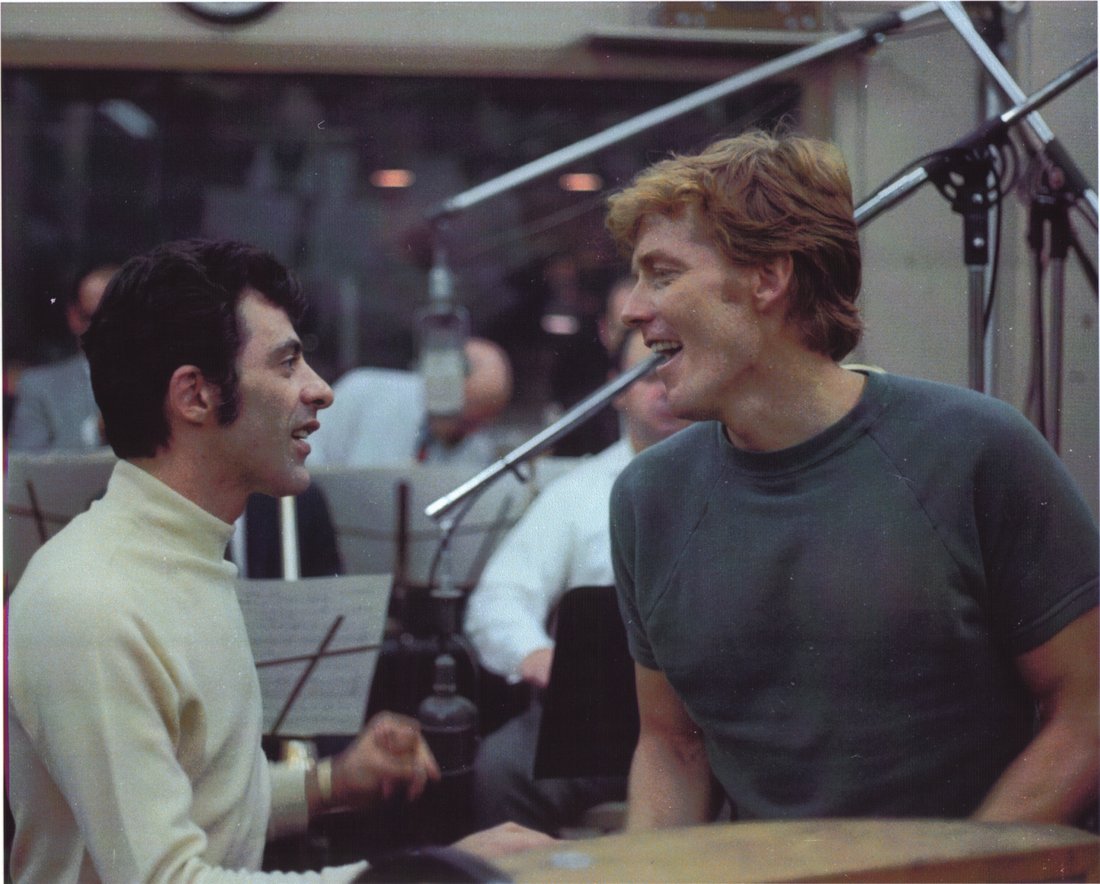
The idea was to leave one or two tracks open for vocal takes. On top of those problems, the sync response on the AG-300-8 recorder was terrible. It was so poor, that I would bounce each group of tracks using the normal playback preamps in order to retain the original quality. (this method placed the new mix track out of sync with the other channels...so eventually, I had to bounce each additional track using the same method, until I had those six tracks in sync. The last one or two tracks used for vocal were monitored using the sel-sync, since Frankie’s track never needed to be bounced. That’s why the quality on Beggin, My Mother’s Eyes, Can’t Take My Eyes Off You, Marianne, and all that group of songs sound as good as they do, so long as Rhino didn’t ‘bum them up’. However Crewe always went to Bell Sound for mastering to disc, and Bob would often add Bell’s live chamber to what I had used via the stereo EMT at Mira. This often caused the different amounts or type of echo to be so obvious. He would drive me crazy because I didn’t like Bell’s chamber...it’s bad enough that I can tell a record made at Bell because of the room leakage and the sound of their echo...I didn’t want that for mixes I made at Mira. I do believe we had a better sound at Mira. I used a modified RCA limiter which had the Columbia records mods, and at times used low frequency cut-offs to shape what leakage was inevitable at Mira. The problem in those days was simply that you had to have a good picture in your mind as to what the final mix would sound like. In the mono to mono overdubbing during the early days of mixing, it was imperative that you had a clear understanding of what the final product would sound like...you couldn’t always go back to correct the mix. So when Bob came up with all the overdubs (sometimes using three horns, - three or four times - you had to understand what was being asked for and make sure it sounded like a single group at one sitting.
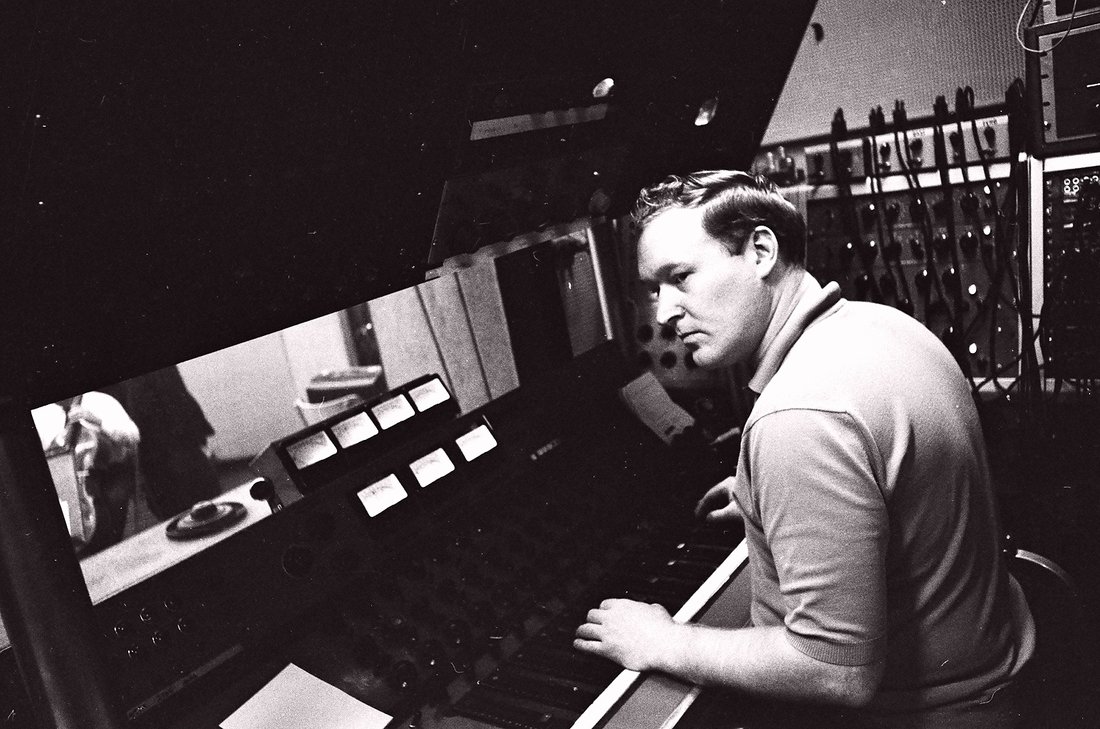
The musicians often came back in an hour later, in order to avoid the union rep who might show up during the session (since overdubbing wasn’t in the union’s vocabulary).
So now , when people are looking for the original multi-tracks in order to make stereo, they don't understand that the very thing they are looking for may not exist in the form they think-of as multi-track.... and if it did, it wouldn't be in matched pairs of tracks. Crewe even challenged sixteen tracks with all the ‘chachkas’ he would add. In many cases, I mixed live stereo two tracks during the session...most however, were quick mix-downs upon playback to the orchestra.
You can be certain that Crewe never thought of releasing in stereo on the early stuff at all. It wasn't until he rushed in one day to do ‘Girl Watchers’ as a cover record that he asked me for stereo because it was a live large orchestra session with very few overdubs. "What Now My Love" with Mitch Ryder was done for stereo during that time period. Don't forget that only the large studios like RCA and Columbia had deep pockets for multi-track machines...and even then, Columbia’s first eight track recorder was built with four model 354 electronics and a 300 deck...see my photos of that machine on my photo disc. Smaller studios couldn't afford the cost.
We got the first sixteen track recorder at Mirasound only because we were going to use a 2" video deck with AG-350 electronics which we already owned. We then asked Ampex to make us 16 track heads for it. They came back, saying that since it was going to have the ‘name’ Ampex on it...they wanted to build it and lease it to us. They gave us a good deal and we could then afford to purchase it without all of our own work in building it. The rest is history. The day we received the unit at 10 am., I did the very first 16 track session of "With This Ring" by the Platters at 7pm with Luther Dixon producing". We believe that George's first recording with the Four Seasons was 'I've Got You Under My Skin' in Spring 1966 . Amongst the first 16 track recordings we know have survived on multi-track was ‘Raven’ with the Four Seasons which was found in the FSP archive.”
What we have now on vinyl and some CD releases is as good as it gets, it seems, but as a starting point I believed that we needed to collate all we knew re the groups recordings and to lead to a comprehensive library of masters in mono and stereo. That the Snapper Music Box Set did not achieve this is down to the Company and the Sound Engineer not engaging in the ‘quality control’ of those early albums on to CD for the set. Sad after all of the collective work…...but true.
My DIGITAL ARCHIVE is as accurate as possible collection of ‘best masters’ to fit the ‘Sound Test’ levels in our CD Discography Page and we [but mainly future generations]will someday be able to share these ‘the recovered Masters’ with Full Frequency and Dynamic Range in mono and stereo from my quality review of all major album CD issues. For those who are technically minded here is a visual demo.
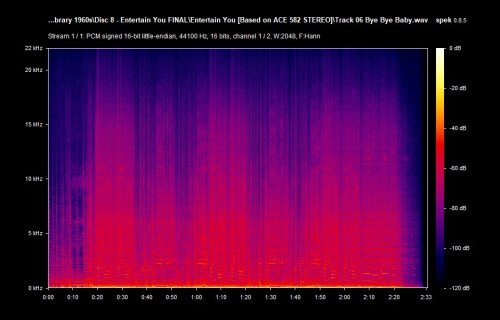
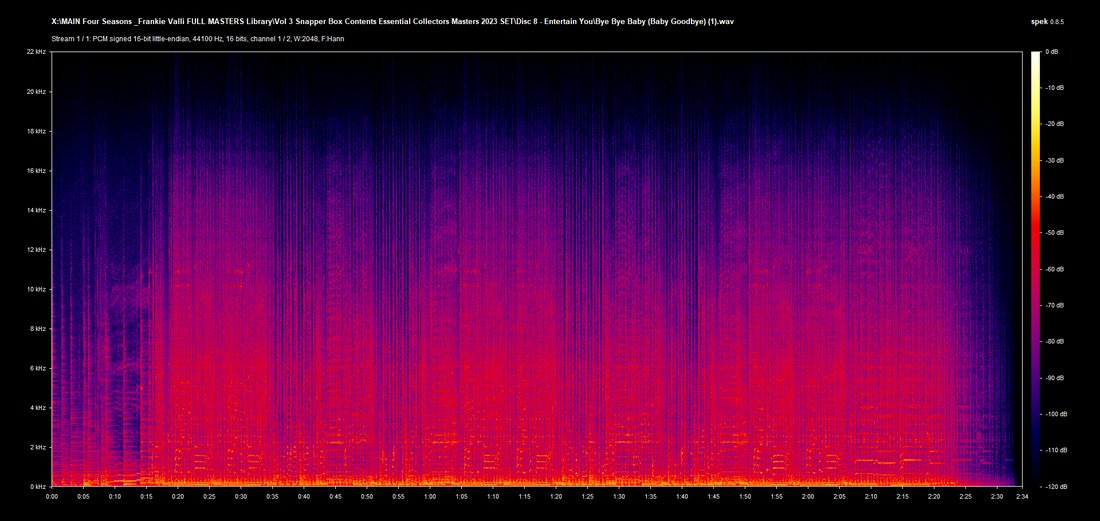
Simply put ‘peaks and troughs’ means higher peak, deeper reds and and more blue gives a better ‘master’ which is in our ‘Digital Library’. The first version is a more pleasing and ‘original intent’ sound. Both are listenable and older ears may not notice the difference.
But the modern prospect of AI power has enabled us to digitally extract the sound and re-mix them. Will AI technology to give us something like an acceptable NEW STEREO remix that retains the studio sound.? I will explore that in Part 3.
The CD Era reveals the Problems of Past Masters
Over the last 3 decades since the emergence of CD and transfers from various source tapes by Rhino/Curb/Ace and others, sound engineer Stefan Wriedt and I were always asking if we have the best possible recordings from those early 1960s sessions.? We have seen the release of the ‘Ultimate’ Box Sets for Four Seasons fans with the Four Seasons Partnership[FSP] working in the past with Rhino/Curb and in 2018 with Snapper Music of London. However finding the Tapes in storage of reputedly ‘masters’ with Bill Inglot and his new transfers to digital files for this most recent issue, the process, has raised the question of what are the best available tracks re-mastered to modern CD standards?. We didn’t ask to hear or check the quality of the ALBUM master sets during the latest transfers and wrongly assumed they were/ would be ‘the best’ [given today’s mastering equipment and software] . The 1960s CD versions as issued in 2023 are below an acceptable sound engineering standard up to the 1968 album masters [Discs 16 and 17] and worse than earlier digital issues in many cases as demonstrated above on ‘Bye Bye Baby’.
The Snapper Music Research Project showed, due to poor Quality Control, that the 2023 Snapper CD versions are inferior to the many 1990s STEREO CD re-issues based on ‘Pro-tools’ transfers during that period. There are no written records as to who did these further transfers after Bill’s initial work up to 1990. My CD Review on this Blog only shows the results and the best re-masters that still exist. Fortunately I have been able to collate and salvage these in the ‘Digital Library’ Archive as replacements for the Snapper Discs.
Remastering during the Digital Era
So what does re-mastering mean? As Sound Engineer Stefan Wriedt told me …. “Any ‘digital’ record collector needs to understand the process behind the creation of the hits they love before considering a purchase of such tracks!!” ...or so it was back in the 1990s. Today in 2026 ‘streaming’ versions are not collectors items and just like radio consumption. They are ‘short term rentals’ …...and if that is good enough for you then you can stop reading now!! But today with streaming subscriptions stabilising, the music business is starting to push their ‘High Quality’ Audio streaming services to boost revenues…….so as has become clear the question is ‘which masters’ are they using? And is collecting ‘digital’ file masters re-emerging.?
The CD era destroyed the music business for them as owners of ‘masters’. Once they ‘grabbed all of our money’ ….we ‘owned the music' …(as long as our discs remain readable - but that is another story)..Back then Stefan and I asked ‘did we have the best mastered true versions?’ . Well after being the ‘Master Track Adviser’ on the Snapper Music Box Set I can say…..not for all of the tracks from 1962 to 1967. Paper records from the Vee-Jay and Philips era are limited but what we know is collated here.
Wikipaedia provided a suitable baseline explanation re the confusion re what is a ‘MASTER’… ”A master is the recording which is duplicated into other formats i.e. LP records, CDs, DVDs etc.[ed...including streaming]. Problematically, several different levels of masters often exist for any one audio release. As an example, examine the way a typical music album from the 1960s was created. Musicians and vocalists were recorded on multi-track tape . This tape was mixed to create a stereo or monaural master. A further master tape would likely be created from this original master recording consisting of equalization and other adjustments to the audio. More master recordings would be duplicated from the equalized master for regional copying purposes. Pressing masters for vinyl recordings would be created. Obviously, master is a fairly loose term, one that can be used for many stages of the recording process, however, all vinyl records would derive from one of the master recordings.”
Thus, mastering refers to the process of creating a master. This might be as simple as copying a tape for further duplication purposes, or might include the actual equalization and processing steps used to fine-tune material for release. The latter example usually requires the work of mastering engineers. The problem has been ‘STORAGE’ . Someone placed a ‘reference’ copy of the album track or MONO 45 version on to analog tape and it has been retrieved 25 years later. My Post-Snapper research has been based on the quality of the versions NOW in digital (CD standard wav file) storage from some 30= re-issue albums. That is ‘the holy grail’ for anyone who want a ‘collection’ of their own.
By 1967 and the advent of 16 track recording [ for Frankie Valli/Four Seasons recordings] the tape quality was much higher and better masters have survived such as ‘The Genuine Imitation Life Gazette’ Safety Copy MONO and STEREO Master Tape, [which are superb] but the ‘Timeless’ album MONO mixes are lost but for what we salvaged from a damaged tape in storage. The Motown Tapes from the early 1970s proved to be in superb 16/24 track tape copies and this shows in both the 2008 Motown Anthology and Snapper Music Box Sets.
The reason is that with the advent of top quality magnetic 16 track tape in the early 1970s and digital recording in the late 1990s, many mastering ideas changed. As Stefan Wriedt concluded…...
"Previously, creating new masters meant incurring an analogue generational loss; in other words, copying a tape to a tape meant reducing the signal-to-noise ratio , or how much "music" was on the tape versus how much "noise" ( tape hiss , static, etc.) Although noise reduction techniques exist, they also increase other audio distortions such as azimuth shift , wow and flutter , print through and stereo image shift . With digital recording, masters could be created and duplicated without incurring the usual generational loss. As CDs were a digital format, digital masters created from original analog recordings became a necessity.
Ideally, because of their high resolution, a CD or DVD (or other) release should come from the best source tape possible, with the most care taken during its transfer. This does not always happen. The earliest days of the CD era found record companies using whatever tapes they had lying around to create their CDs, with frequently underwhelming results. An ‘nth-generation’ tape equalized for vinyl frequency response might be deemed perfectly acceptable by a record company, and (importantly) might be much easier to locate than the "original" source master. Additionally, the earliest days of the CD era found digital technology in its infancy, which also aided often poor sounding digital transfers marked by dropouts, underutilization of Signal-To-Noise Ratio , etc. ….When the first CD remasters turned out to be bestsellers-- [for example Rhino’s Four Seasons 25 th Anniversary 3CD box set ], the box set boom began as companies soon realized that new editions of bare-bones back catalogue items could compete with new releases as a source of revenue. Back catalogue values skyrocketed, and today it is not unusual to see expanded and remastered editions of fairly modern albums .
Theoretically, digital remastering in 2015 should solve some of these problems. Original master tapes, or something close to them, can be used to make CD releases. Better processing choices can be used. Better prints can be utilized, with sound elements remixed to 5.1 and obvious print flaws digitally corrected. The modern era gives content providers almost unlimited ways to touch up, doctor, and "improve" their creations and products, and as each release promises improved sound, video, extras etc , producers hoped these upgrades would entice consumers into making a purchase.”
What Stefan wouldn’t realise at the time that within 5 years Sound Engineers would be able to de-construct all elements of a song[whether MONO or STEREO] and re-construct the sound placing vocals and instruments to create a RE-MIX with a completely new ‘sound-stage’ never envisaged by the original producer. But it would not be the ‘original’….even if it sounded better.
Recovering the ‘original’ masters was the promise by Snapper Music back in 2018 to the UK Fan Club ‘team’. Today and for the foreseeable future only vinyl releases are creating enough of a return for Record Companies and older Four Seasons fans are unfortunately entering the ‘passing away ’ era for them as ‘baby boomer s ’
So re Frankie Valli and the Four Seasons in the 1960s
All of the evidence so far is…..there are NO ORIGINAL MASTERS.!!
As I have said in Part 1, with the focus in the early 60s being on the sound of the MONO 45 there are tales of sound engineers not being asked to be careful enough to produce a decent STEREO version[e.g. ‘Beggars Parade’ in Stereo]. Why was that? Well the studio technology at the time was limited, but surviving Masters from the Vee-Jay ‘Delivery Tapes’ are pristine two track STEREO but NOT as shown in Part 1 the separately stored ‘album master Safety Copies’.
Questions arise re the music creation but no-one today seems to take any academic or sound engineering interest in it. Questions Stefan and I have asked about the catalogue are not researched as has been done with The Beach Boys and The Beatles. Questions such as…..
”how was the classic sound created on vinyl? Where are the original multi-tracks.? Did they ever exist or were they wiped/dumped? What is left in the Philips storage and where are they stored? When did ‘good’ stereo come to the fore?”
The questions are numerous and only partly answered by my research so far.
I have George Schowerer’s 2010/11 interviews to address some of the background and answer the first question. Back in 2010 I wanted to ask a sound engineer from the 60s about the process and to understand why we don’t have the quality today that we would like. But I felt it was worthy of putting it on record in 2026, not knowing then whether he was still with us.
Sadly, George Schowerer passed away on June 10th 2026 at the age of 94. I am so grateful for his time and feedback re life in the studio with The Four Seasons, Bob Crewe and Ellie Greenwich and Jean Thomas, and his wonderful photo library at History of Recording.
George Schowerer confirmed what Wikipedia says and gave some reasons why we can’t always be sure that what we hear is closely related to the original recordings…….
”When the old Rhino 25 th anniversary CD box set came out, I complained bitterly about the quality of the mixes I had done. They were not equivalent to the mixes that left Mirasound. Eventually, in conversation with Bill Inglot, he acknowledged that in some cases, the record company involved would not [at the time] release the original tapes [to the FSP]...only a [safety]copy...and depending who made the copy, you got whatever you got at that time.
Now, when I chided Rhino about the quality of some of my mixes, I quoted a CD I had (in my library) manufactured by Ace Records from England(CDCHD538) Solo/Timeless by Frankie Valli in which the transfers were the best I've ever heard of my material from Mirasound...so I know that good transfers do exist!
Bill Inglot indicated to me that the reason for the earlier Rhino 25 th anniversary album sounds (them being distorted) were due to the quality which the record companies supplied to him. [ ed….actually the FSP? ] He said that in many cases, the record companies destroyed the multi-tracks to avoid misuse ,...remixes etc. I think that's crazy, but I haven't lived their life of problems with cover records in that era or tape storage.
The stories surviving are ‘anecdotal’ and include one that the Bell Studios were having a ‘clear-out’ as we cover below with George and certainly the only surviving session masters found in our review were 4 high quality session mixes of ‘Raven’ from 1967. These are George’s mixes, and one is included in the Snapper Box set.
George continues…..”I remember that the business [back in the late 1980s] was ripe with copy records which cut into sales of the original discs. And then there was plain bad remastering. I remember when the first CD of ‘Bread’ came out, I thought it was a "cover" record! The classic "sound" wasn't there...it was replaced by a very "sterile" mix sans echo...and it was obvious that someone had gone back to the multi-track masters and started mixing them over again without ever listening to the original releases that made them hits! I don't know what I would have done, if I was responsible for holding master tapes...but then again, I'm one of those people who save everything (much to my wife's distress). “
There are two distinct sets of Record Company Masters that we found in the Four Seasons Partnership storage in LA when Bill inglot was commissioned in 2018 to support our research [the late Bob Fisher and I]. It soon became obvious that some ‘cannibalisation’ had gone on to create suitable album Masters for 1980s release on CD.
Secondly there was an assumption that the quality of surviving analog tape masters of Frankie Valli and the Four Seasons recordings in STEREO from the Philips period in the mid 60s was good, given that we had the quality of ACE releases during the 1990s. That assumption was largely wrong and what we had was just good mastering from ACE. Back in 1964 recording with Philips certainly was not so easy on the 4 track consoles after the 8 track at Atlantic for ‘Dawn’ and ’No Surfin’ Today’. Sound quality issues were apparent at the time of the departure of Charlie Calello who was the primary arranger for them in late 1965
Charlie Calello has advised that they were experiencing ‘distortion’ on their efforts to create great sounding recordings at Stea-Philips and Olmstead on the ‘Working My Way Back To You’ album and there is evidence that Stea-Philips needed to update the facilities in 1965 with fund raising efforts by the company at the time. Bob Crewe and the group had to move……..and a critical period in their production process was about to unfold.
The possibility is that in 1966 that Frankie Valli ‘solo’ releases on SMASH were recorded at Bell Studios (as Crewe we understand was part owner) or Dick Clark Studios although there is no studio credits on any of the vinyl release for this short period. Researching this I found the following developments credited to Bell….
” The studio's research and development team developed a new 12-track 2-inch tape recorder that offered higher-quality recording than the 8-track 1-inch and 16-track 2-inch recorders in use at other studios. Early adoption of 12-track 2-inch technology introduced an unforeseen challenge, however - as the only studio in New York City using a 12-track 2-inch device at the time, so recordings produced at Bell Sound lacked compatibility with other studios……...It was one of the first studios to allow engineers to specialize in mixing, and this could be requested by a client” As a result they had to accommodate final stage mastering for vinyl with added overdubs to STEREO Masters."
George Schowerer recalls his first recording of the Four Seasons at Mirasound was on ‘I’ve Got You Under My Skin ’ in Spring 1966 and Bob Crewe used Bell for his final mastering stages as we will hear from George. However, the real problem with the preservation of multi-track tapes from the Philips period pre 1968 may have been the ‘sale’ of Bell Studios in 1968 after the death of the owner Don Cronin in a plane crash [and a subsequent clear-out of the studio storage] which probably led to the dumping of the Four Seasons Multi-Track Masters in a skip after they were not collected and this connects with quotes from George and Bill Inglot. Whatever happened[and when], we know that Bob Crewe did salvage a set of quality STEREO mixes from them for the superb recordings on the ‘Edizione D’Oro’ vinyl 2-disc set in 1968.
But what has survived from the Mirasound Studios shows the best standard of recordings from 1967 on. George Schowerer had his own approach to avoid ‘distortion’ as was reported at Stea-Philips by Charlie Calello
George Schowerer confirmed….“Many of the Season's recordings that came out of Sound Center in New York had distortion due to the many numbers of overdubs that were a trademark of Bob Crewe's work. I believe the reason for the distortion was the fact that in those days, the playback quality in the "sync" position (in order to add tracks while remaining in sync), was god-awful! So were the consoles used in many of the famous hit records. That's why I pioneered(the use of normal playback during the addition of tracks. This was because of Bob's penchant for multiple, multiple tracks at any given session...the number never consistent, but could reach 20! In other words the small section strings might be overdubbed three times in the course of the session...same for the horns, etc. The only problem with that method is that all tracks would have to be overdubbed to maintain sync overall. But the quality remained first rate. The only track (or tracks not "bounced") were the final vocals, since playing back all the music tracks in sync position were only for the benefit of Frankie's headphones.”
So I asked George if our expectations of sound quality today[then 2010] from these early recording are too high. He told us…….
“ As for the aspect of why many of those recordings cannot produce a current expectation of today’s mixes is very simple. Take "Can't Take My Eyes Off You" for example, by the time the overdubbing was bounced so many times, the mix of strings is down to one track of a multitrack ( 8 track master in this case). This is the same for each section of the orchestra. So, this prevents a nice spread of the orchestra in stereo...keep in mind that none of the works in the mid sixties had anything but a MONO single 45 rpm record in mind. That's why the stereo mixes coming from those days have such a ‘ping-pong’ stereo balance. We didn't have the availability of the equipment used today. The Mirasound mixing board had just twelve inputs and four output buses! That's why the photos at Mirasound show additional mixers. During the initial session, we used all inputs, sometimes even used the outboard mixers! Then, during overdubs, I switched the use of the console, using eight of the input faders to monitor (in stereo, since I loved stereo ahead of it's time) the eight channels of the recorder in use. I used the other four inputs on the console (and sometimes the outboard mixers as well) in order to feed the eight track Ampex with the newly overdubbed material. When you work with Bob, there were several channels of hand-claps and tambourines alone, which were all mixed together and "bounced" to one channel. I have no idea what was coming next on the sessions until Bob decided on the spot what to add...so trying to keep the overall picture was quite challenging. But I know what left the studio was clean because of the use of my playback method. As for the method used on the Seasons, in the mid 60s, we would record the basic session onto 7 of the 8 tracks available. Then the process of clearing room would start. Multiple channels of drums, horns, or strings would be mixed together (each group separately) and "bounced" to a single track. This would free-up several channels for overdubbing. Any further additions of strings (for instance), would be mixed again to a new channel so that, once again, all strings were relegated to a single channel...and soon! This is why the tapes of this era cannot make satisfactory updates, when the original intention did not allow for stereo spread of any string or horn group (rhythm included). Since we only had one 8 track machine, this was the only way everything could be mixed for a mono hit record. If we had had two machines, then you could have gone back to earlier generations and recovered material in a straight-forward manner. We didn't have those options back then. I had pretty much imagined what Bob would want as a final product, and always kept that image in my mind while over-dubbing the brains out the music. In many cases, he graciously let me do the compilation at hand and I know he felt comfortable with my work. I still cringe when I hear some of the Season's stuff (which was not my work) that was turned into stereo and the resultant selection of where they placed some [instrument and vocal] tracks in the mix (but then stereo was never the intention of the original producer).”
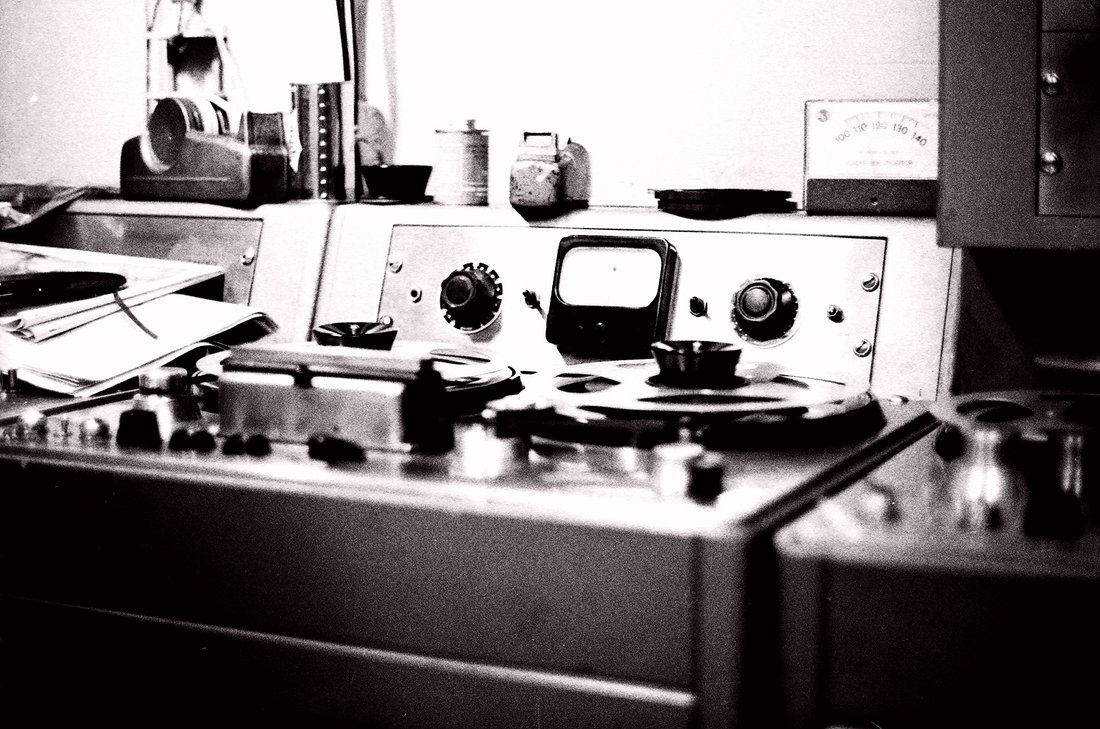
So all we could do in the Snapper research was to trust that the engineering of transfers from the limited sound quality tapes that still exist in the FSP storage would exceed those done for past CD issues... but we didn't get a chance to check for the problem of time in ‘storage’ . And we showed the problem visually in Part 1.
But as I will cover in Part 3, with modern PC based software it is possible to simulate a ‘full spread’ STEREO mix now with AI creating multi-tracks as instrument/vocal ‘stems’ from the best surviving digital masters in that original ‘ping-pong’ [wide] two track CD Stereo. And it remains a question as to whether anyone other than amateurs like me would spend the time creating new mixes…..as George says… ”it is a matter of cost…. But money is money...in whatever form it is created” …..and maybe someday the technology will enable other exciting alternative mixes to be created from the masters that have survived, and they can create ‘new money’ for the owners of the Masters[Frankie and Bob]. It needs someone to see a financial return in finding and paying a good sound engineer to create the best possible AI digital re-masters as has been done with the Beach Boys and Beatles masters. More and more AI tools are appearing and ‘spatial enhancement’ music player tools can add more to create a studio sound as the artists intended. A modern and enjoyable version that shows all of the arranging and producing skills from back then...in a new ‘sound-stage’.
And George confirms the reason why no 1960s Bob Crewe Valli/Seasons multi-tracks have survived or could be found by Bill Inglot……. ”I have heard many engineers say that when libraries were full to the brim, studios would notify the various "owners" as to the need for retrieving their tapes. When no one appeared to come for those tapes, studios would then dump them, because they needed the space. Most studios in those days didn't charge for storage and the various companies took advantage of that fact! While I don't have the reasons why they sat so long in the studio libraries, I do remember many people not showing interest in picking up their stuff. If memory serves me correctly..Bob Crewe took most of his final mixes after our sessions, up to Bell Sound. When Bell went out of business, a lot of those tapes went into the dumpster if no one retrieved them after notifications went out.....this may be why some are missing. You wouldn't believe how many tapes went to the trash because of lack of claiming the items...I don't know if it was due to not having storage space in the record company offices...or what. But it did happen too often for comfort. Once the hit record got out, I guess there wasn't much demand for the tape because they were forever making copies of the master mono tapes for foreign distribution. I guess the original people must have felt that it was now the problem of whomever they sold the masters to. It was a case of the cost. It sure is different now that original masters are so highly valued “ [ed..if you can find them….particularly on 16 track or higher].
After the ‘Genuine Imitation Life Gazette’- ‘failure’ when Philips subsequently lost confidence in the groups ability to create ‘hits’. From 1969 on, Bob Crewe paid for studio time and presented the completed MASTERS[mixed to STEREO] to the Philips and that was shown by the ‘Half and Half’ Master Tapes which were found in the FSP storage mixed by Gaudio/Crewe to Mono and Stereo and presented to Philips for release.
And George concludes his feedback as the first sound engineer to master Stereo from a 16 track console for them…...
“I hope this gives you some needed answers to the many questions about resurrecting the old material. The mono stuff is set in stone, while the eight track stuff will be ‘stiff’……..and the only thing that would allow for a good stereo mix is perhaps the 16 track stuff. I was fortunate to be the first mixer to use 16 tracks…….the very first session on that machine was "With This Ring" by the Platters, produced by Luther Dixon”
The research finds of ‘unreleased’ tracks and replacement of missing MONO 45 masters from vinyl dubs [e.g. ‘The Sun Ain’t Gonna Shine’] made the completion of the Snapper Box Set challenging….BUT with no input to the sound engineers strategy or control of his final selection and quality of masters, [after Bob Fisher’s untimely passing]…….. as a result for the early years discs the sound quality and the anthology box set suffered [also with some tracks missed or incorrect versions used].
Bob Gaudio may have been happy with the outcome but sound quality collectors like me wanted …..and still want more….and suddenly AI comes along…...but in the FSP no-one is listening. Bob Gaudio didn’t like the prospect of using any ‘spectral’ digitally extracted sound. That is his personal preference and I respect that. But I ask the question for the future……..’WHY? When mixes are clearly ‘unbalanced STEREO’ Well one answer might be because the cost out-weighs any financial return. It is all about the money!!
So what can be achieved from the ‘best quality’ salvaged Masters? Maybe only music historians with basic sound engineering experience can achieve something of interest to the fan groups?
Back with Part 3 and what to do with examples currently and only available on STEREO CD with Frankie Valli and all instruments in the left channel and group on their own in the right.
And Then there was Artificial Intelligence!!!
It was 2020 and the Analogue Tape transfers from the Four Seasons Partnership’s Tape Storage facility were rolling in from Bill Inglot when I wrote in this blog about the problem with STEREO in the new decade and the new technology emerging after looking back at the way Stefan Wriedt and I had felt back in 2006.
And quoting my blog from back then…….“I was listening to the ACE CD transfers from the 1990s on my I-pod on headphones recently (2006) and …….I realised they were nearly all STEREO but were making me cringe! Why? Well..... nearly every track in STEREO from every album from 1962 to 1967 was in wide STEREO…...in many cases the instruments were across the park and the harmonies in my neighbours garden and Frankie Valli's vocal was in my head!!!! ….with all this headspace in between…...so I decided.....I've moved beyond this.”
Looking back it becomes apparent why it was this way from interviews and research. They show how things had developed in terms of Bob Crewe’s recording techniques in the Stea-Philips 4 track days and by the time he moved them to Mirasound in 1966.
George Schowerer again explains how…..
As for the method used on the Seasons, in the mid 60s, we would record the basic session onto 7 of the 8 tracks available. Then the process of clearing room would start. Multiple channels of drums, horns, or strings would be mixed together (each group separately) and "bounced" to a single track. This would free-up several channels for overdubbing. Any further additions of strings (for instance), would be mixed again to a new channel so that, once again, all strings were relegated to a single channel...and soon! This is why the tapes of this era cannot make satisfactory updates, when the original intention did not allow for stereo spread of any string or horn group (rhythm included)”.
[Ed...Well maybe ?….if an Engineer like Mark Linett was around as you can read in Part 4]
“ Since we only had one 8 track machine, this was the only way everything could be mixed for a mono hit record. If we had had two machines, then you could have gone back to earlier generations and recovered material in a straight-forward manner. We didn't have those options back then. I had pretty much imagined what Bob would want as a final product, and always kept that image in my mind while overdubbing the brains out the music. In many cases, he graciously let me do the compilation at hand and I know he felt comfortable with my work. I still cringe when I hear some of the Season's stuff (which was not my work) that was turned into stereo and the resultant selection of where they placed some [instrument and vocal] tracks in the mix (but then stereo was never the intention of the original producer).”
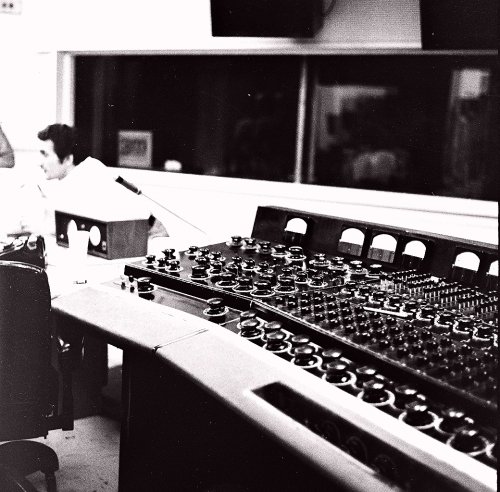
Here is a retrospective re the background as to why this happened.....what the sound engineers tell of the times the first STEREO albums were created back in the 60s...... ”those early stereo mixes were limited by the technology of the time. The industry was still learning how to bring this new fangled thing into the world. It is really common to hear a ‘60s stereo mix where all the guitars are on one side, the vocals on the other, and the drums in the middle with absolutely no bleed-through at all. This is called “hard panning” and it can definitely make for a challenging listening session, depending on your room setup and personal preferences. It may or may not be fun with headphones too.!! At first, Stereo was something of a novelty. It wasn’t commonly listened to, and therefore was a bit of a gimmick. The first Stereo mixing consoles were typically 2 track or 4 track mixing desks. This meant you were limited to separating only 2 or 4 individual elements in the Stereo image. Using The Beatles as an example, the first two albums in Stereo were 2 track, so if you listen to them, you will notice all instruments are on one side, and all vocals on the other. This is what people mean when referring to ‘hard panning.’ This even continued when they started using a 4 track desk (I Want To Hold Your Hand), and even the incredibly dense sounding Sgt Pepper was made using a 4 track desk. Mixing huge instrumentation arrangements was possible on 4 track by using a technique called ‘bouncing.’ I won’t go into that here, but you can google it to find out more.
Because Stereo on commercial pop records at this point was a novelty, and a new exciting technology, and because engineers and producers of popular music were new to the idea, early 60’s music in Stereo generally sounds quite primitive. When you have only 2 track Stereo, hard panning is the only option to create a crude Stereo image, and is essentially redundant. But even with the advent of 4 track stereo, you will find that instruments were still hard panned (i.e the drums all on one side, vocals one side, guitars in the middle etc….) It is only towards the latter part of the 60’s, and with 8 track or 16 track becoming more common, that Stereo mixes started to sound like what you would hear [created] today, with instruments placed in a realistic and pleasing stereo image. One danger today is that I know that for one or two big labels, once Stereo became the standard, they thought their mono masters were now worthless, and they destroyed them (or wiped them and reused the tape.) So the mono 45's of these songs are the only way to hear the best-sounding mixes of these songs.” Hence the need for a MONO ARCHIVE and a set of NEW STEREO MIXES.
We now know the way Bob Crewe created these releases and Charlie Callello’s book….. ’Another Season’ demonstrates what I have written in this series from George Schowerer and others. With the technology of the day in both studios and people’s homes MONO was the best choice….and what was sold to fans.
A BSN Forum member confirmed the detail of Charles Calello’s and George Schowerer’s descriptions. …..
”For the tracks recorded on 4 track before "Dawn" (which was done on 8 track, so plenty of tracks available for overdubs), this was the typical approach in the 4 track days at Stea Philips/Olmstead studios:
Crewe records the musical backing tracks on all 4 tracks of the 4 track machine. [Drums, Bass and rhythm guitars, piano, organ etc] These 4 tracks are mixed down to mono onto a mono tape deck The mono tape is now re-recorded onto Track One of the 4 track. This leaves 3 tracks open The Seasons (with Frankie) record their background vocals onto Track 2 To double the background vocals, the sound on sound technique is employed. The Seasons sing along to their previous background vocals. The original background vocals AND the new double are both recorded onto Track 3 Track Two, with the original background vocals, is erased. This leaves two tracks open Frankie adds his lead vocal onto Track Two Frankie doubles his lead vocal using the sound on sound technique. Frankie's original vocal AND his new double are recorded onto Track 4 Track 2 is then erased The final sweetening for the record, which could be Percussion, an added Organ, Foot stomps, etc, is recorded onto Track 2 All 4 tracks are now full, and the Single Mono Mix is made (with reverb, etc) to a Mono Tape deck.
This was very intelligent track management of the 4 track machine, which yielded, essentially, 9 tracks of music. Yes, there would be some hiss added from the sound on sound overdubs, but that was normal for the early 60s. Also, the cutting engineer would use some intelligent EQ to help minimize it on the record. So the whole production was geared to a MONO product. All the hits were made that way and heard that way....on record players and radio....throughout the first 7 years of the decade hardly anyone[fans] had a STEREO record player.....and as stated above that was the gimmicky alternative version. “
BUT my question remains…. .
”what is the 'Best Mix' in STEREO possible today, with the technology of Artificial Intelligence? “
It would seem based on the above that no-one will be able ever to overcome the deterioration of instrumentation mixed down to one track in the recording process[i.e.’bouncing’ loss]……..or can we salvage more...as we roll through 2026 with greater levels of separation within good digital sound files?
By the time CDs arrived from 1988 on, the stereo 'wide' mixes of most albums had become the “official” [defacto]mix.[now on CD, streaming and You Tube] As vinyl records went out of print, people were left with only this STEREO option when they bought a new copy on CD[apart from a couple of UK re-issues of their first 3 albums by a UK independent]. BUT that is the BONUS for AI purposes as some of these are in the main good transfers from analogue tape [STEREO Safety Copies] to digital and gathered in our archive.
With the extraction capabilities of AI thatI have been researching, if it is possible to create a decent STEREO sound stage for the tracks that were never mixed to STEREO such as the MONO 45 versions of ‘Dawn’ and ‘Ronnie’ et al?. It has been possible to extract between 6 to 9 elements of vocals and instrumentation from the MONO 45 versions and with careful placement create an alternative to the surviving MONO mixes. Then with the separation possible on the two channel STEREO tracks from 1962 to 1967 it is possible to create 12 to 14 elements to create balanced STEREO thus overcoming the ‘ping-pong’ effect of the currently released and streamed original[‘official’] mixes. With the over dubbed instruments, the best possible solution seems to be to lift up the extracted bass, strings, chimes etc [that were bounced to on track back then] in the mix so more of them can be heard with noise reduction and spatial enhancement on horns and strings which makes them clearer and more effective
So today my argument is we need top re-mastered versions of those transfers as the BEST STEREO baseline mix available. I have researched back through the 80s and 90s album re-issues to find the best Frequency Response and Dynamic Range copies to construct the NEW MIXES that can represent the LEGACY.
The process starts with a technical approach as my late friend Stefan Wriedt, a German sound engineer addressed the question...
‘how do we as fans make our own assessment of what is a good stereo mix of Frankie Valli and The Four Seasons?’.
“ Stereo images are best assessed on headphones. You have to listen. Wide is 120 to 180 degrees, anything between 60 and 30 degrees is small[narrow], 60 to 120 is normal (90 degrees is usual). I haven't found any meter / display that can show this.[only our ears on headphones]”
So I started doing further research on the 'best mixes' in STEREO and the groups catalogue and realised all the 'best sounding’ STEREO were recorded in the 1970s and obviously on vinyl. There are some rogue STEREO mixes that surfaced on 'special' vinyl albums during the 60s[e.g. Edizione D'Oro] and 70s [Frankie Valli ‘GOLD’] that are alternate mixes, but every STEREO version is different as the content is more detailed than the MONO and can be panned differently. Often the MONO versions on 45 were speeded up by Bob Crewe for ‘Radio play’ and have a different tempo altogether.
The 60s STEREO limitations are clear. CD's with this WIDE STEREO can sound normal to good on an 'old style' listening environment when the speakers are the right distance apart and the listener is in the 'sweet spot'. The STEREO then becomes just like ‘in the room’ MONO. This represents probably less than 5% of anyone’s listening experience today as we all listen on headphones/ear-buds/in-car or ‘on the go’ phones. And after spending 3 years collecting and restoring MONO mixes from vinyl [in the 2010s] it has become obvious how the groups PRIMARY catalogue elements should be delivered. In MONO as originally intended for both 45 versions and albums with new DES 'AI enhanced' STEREO versions as a bonus set. Unfortunately the Snapper Music Box Set did not achieve this for the period from 1962 to 1967.
However , it became apparent from Bob Crewe mixes in 1967 what his ‘model mix’ was in STEREO as found back on the DAWN album. When he had the technology and the right engineer to work with, he had a distinct idea for instrument and vocal panning for STEREO. On that album 7 of the tracks are mixed with the Four Seasons centrally set on either side of Frankie’s strong lead vocal. Drums are placed in the left channel with Bass enhancing that channel along with ‘pluck’ guitar. The right channel has piano/organ and rhythm guitar along with horns which can also be varied in placement to suit the song and vocals. The aim he had was always a balanced STEREO SOUNDSTAGE. From the Mirasound period of 1967 that was what he achieved with George Schowerer with 16 tracks. In the best commercial audio production and using audio software, panning can be controlled between -100 to +100. Where mostly -100 is the leftmost part of the stage and +100 is the rightmost part of the stage .
Stefan agreed….. ” In the case of the Four Seasons recordings that we have[on CD in STEREO]……….. listen to any track on headphones and see how much these principles are adhered to. Many of the early stereo recordings fall short of this standard (with instruments and vocals panned far left and far right with acres of space between occupied by ‘nothing’).Today with modern recordings the listening experience is different, Everybody who bought a Four Seasons CD already has got the wide-stereo version[except for the tracks never mixed to STEREO by the Engineers] which again goes to the root of the original purpose.....a RADIO 45 mix.”
So we might as well have that..A MONO ARCHIVE.....well mastered with the punch and ambience of Bob Crewe's mixes....in the correct MONO 45 and MONO album mixes. They sound great when mastered well. However the problem has still not been solved by the FSP, Rhino, or anyone else… IN STEREO …...except for a few of us amateur sound engineers who have done it as a hobby.
So with today’s technology and AI, we can repair and enhance the past mixes. That is still what the fans need in 2026...But we need it with ALL the 60s STEREO in this enhanced form. The technology is here to do this for all our playing equipment and listening needs. A completely NEW set of DES Masters
As Stefan said and we found doing the MONO ARCHIVE......
”. The fun is when you are re-mastering and you are trying different settings. Sometimes you suddenly find the groups sound just works better. That is such a ‘buzz’. ..a real adrenalin rush.”
As for the path to acceptable STEREO Mixes….?…..I have created over 30 ‘Models’ using AI on each of the salvaged BEST STEREO MASTERS and re-mixed up to 16 stems as new multi-track extractions. Some 15 of the results can be found on my You Tube Channel and will be assembled for this web site as a playlist for readers.
We are able now to fully appreciate the transition from MONO to STEREO and capture the punch and thrill of MONO and the 'performance simulation' of STEREO in a modern presentation of their music as it is now understood. So NO hard right/left panning STEREO for me....thank you.! I am creating the NEW Bob Crewe MIXES, as he would have done them if the times and technology had allowed him to.
Below is just one of the latest and clearest examples. It is based on the Bob Crewe model mix as analysed from his ‘New Gold Hits’ album which originally had all of the instrumentation in the left channel and the group in the right channel and Frankie Valli’s lead vocal centred.
In my amateur effort to re-construct the sound stage for ‘I’m Gonna Change’ and following the principles above the strong bass-line is in the left channel with the chimes along with the drums and the horns are in the right channel with the ‘pluck’ guitar. Frankie Valli is centred with the Four Seasons ‘double-tracked’ around him. This gives the track the punch as well as balance it needs.
 ►
More in Part 4 as I compare the existing to new mixes
Not every Sound Engineer embraces AI Digital Extraction and Re-Mixing and Bob Gaudio indicated he didn’t like some of the mixes we tried for the Snapper Music Box Set back in 2020 (he may well have changed his mind if he has since sampled some of my ‘amateur’ creations of the 60s tracks on You Tube) but one producer/engineer who is probably amongst the most respected in the industry today is Mark Linett. He has been working on the surviving Beach Boys Tapes for decades and has used all sorts of innovations to create ‘best mixes’ in STEREO . In interview he describes this evolution ….
” The first job I was given was Pet Sounds [The Beach Boys] on CD. This is when CD was starting and after that, I was given the task of putting the whole Capitol catalog on CD. The next thing was a box set called Good Vibrations. It was a 5 CD box set tracing the Beach Boys’ entire career with outtakes, bonus tracks, all kinds of stuff like that. Then somebody got the idea of doing a big box set of the Pet Sounds album and I did the first true stereo mix of that. It had never been done in anything but Duophonic up to that point, largely because of the way things were recorded in the ‘60s. Then, in around ’66 or ’67, bands or artists started being interested in doing stereo records, but if you came from the era of AM radio and pop records and 45 RPM singles, it was mono all the way.
Your typical recording would be that you had the track in mono but then you’d bounce that to another machine and just keep doing that until you had everything you wanted and then mixed it to mono. The Beach Boys records were like that. Brian let the engineers spread the basic track out and do four tracks and then we’d mix that to mono onto one track of a four track, or he took it over to CBS Recording that had the first eight track in LA, bounce it over there and then he would have seven tracks to do vocals.
So, the problem for doing a real stereo mix was that what you wound up with at the end was a mono track on the master tape, and whatever number of vocals. So, the question was, how do we sync all these different tapes up and it really wasn’t something you could do until digital recording came and by the time I did it, we had Sony Dash machines.
So, to do that record, I had to transfer the three-track backing track (I was using a 48 track Sony) then manually sync the overdub reels by playing with the varispeed speed and manually dropping it in using the mono track as a guide and try to get that phasing with the three track combine. When I got it close enough, so it would phase for 20 or 30 seconds, I would dump the whole thing over and then I would move the vocals (because you’ve got drift) using those two band tracks, then keep moving the vocals to keep the band in phasing and wind up with a master that had somewhere between eight and twelve tracks that I could then mix from.
I did it again 3-4 years later when we did a 5.1 mix, but by then we had DAWs (I used Nuendo for that one). Now we have Time Shift, I can sync up a bunch of tapes in half an hour, it’s the easiest thing in the world to do that.
I’ve been using various AI extraction programs a lot recently to deconstruct the originals. Right now, I could deconstruct a mono band track or the component parts of a three track recording and I’ve got more stuff I can move around. It becomes really useful for things like mixes of The Beach Boys stuff, which I’ve done recently, because you’re trying to do something in 12 speakers. So, if I’ve got a mono backing track, you have the bass in the centre and the drums here… a little bit of spread makes a big difference rather than still dealing with the question of ‘where do I put this mono track’? It’s not too bad in stereo, but in surround it gets tricky.”
He even uses IR to recreate the ‘studio sound’. In the realm of audio, ‘"IR" refers to an impulse response, a sound-file that captures the unique sonic characteristics of a specific environment, piece of equipment, or acoustic space. It essentially acts as a digital snapshot of how a sound behaves when it interacts with a particular object or location.’
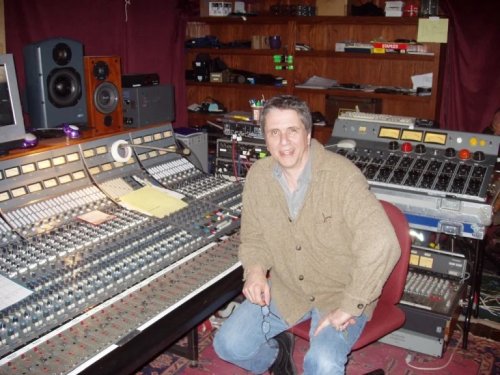
BUT there are no multi-tracks surviving of the Four Seasons from the 1960s and I am playing with an AI extraction site that enables just a fraction of what is possible. But two things Mark Linett and I have in common are an in-depth knowledge of the artists work and a thirst for simply using the creativity the extractions allow.
As he says…. ”My attitude is similar to a lot of people. I would never want to go back to tape or, more importantly, big format consoles, and not mixing in the box. It’s certainly a little bit of laziness and a certain amount of market reaction in the sense that it’s now expected that if you do a mix and the producer or the artist says, ‘I like it, but get the tambourine out here’, or, ‘turn it down’, and you can do that in 15 minutes. So that’s a convenience because it used to take half a day to recall a mix and it was never the same anyway. But mostly, it’s because it allows for creativity in ways that were all but impossible. We’re in the digital age and mixing in the box there’s so many things that you can do – sub buses and side chains and, so forth that would be impossible on an analog console. But, above all, you can just put up a session and just mix. You don’t have to get hung up on the technology, or the method, you can just use the creative part of your brain.”
So if an Engineer with such a creative perception were to tackle the Four Seasons surviving 2 track STEREO Masters, what would he do and what results could we get?
The problem of the ‘ping-pong’ STEREO Mixes of the Four Seasons tracks since their first recordings has been obvious since the first CD issues and are particularly noticeable on headphones with the group firmly set in the far corner of the right Channel. As I have said this stems from the use of 3 and 4 track recording and the ‘bouncing’ process previously advised. But the surviving tracks do offer some opportunities for better ‘Mixes’. Whilst the surviving Vee-Jay ‘Delivery Tapes’ remain a pristine source in terms of Dynamic Range and Frequency Response, those STEREO Masters need correction using the same DES tools and mixing.
As in my Part 4 project on the ‘Dawn/Rag Doll’ albums my review of the subsequent mixing of the 1965 to 67 albums shows a continued discrepancy in the STEREO images on their albums. ‘Entertain You’ has most instruments in the left channel and the Seasons in the right with space between. Again another example of poor 1960s pop mixing technology, some would argue due to Bob Crewe’s ‘bouncing’ process previously described. But that contradicts what was achieved with so many mixes on the ‘Dawn’ album. On ‘Entertain You’ only ‘Little Angel’ achieves the desired balanced mix and this may be due to the harmonic vocal arrangement by Massi and Calello…….so all of the backing and lead vocal were on one of the 4 tracks available ? ...probably!
At the same time the single of ‘Girl Come Running’ was recorded and issued. The STEREO version of this with balanced instruments and vocals would not be found and issued until 1968 for the Edizione D’Oro [when Bob Crewe reviewed the Multi-tracks before they were lost by Bell Studio] This remains a different Take to that used for the 45 MONO release and the STEREO version from 1968 has become the ‘defacto’ version. But it is a GOOD STEREO MIX.
All of the ‘ Working My Way Back To You’ album still has the unbalanced STEREO mix approach and this has been the starting place for my next project of Re-mixes using AI stems, with several You Tube uploads to date from my ‘I’m Gonna Change’ DES Project using the latest sound tools.
Whilst ‘ New Gold Hits’ album was an assembly of mixes from several studios from late 1965 [at Stea-Philips to Mirasound ] and from (probably) 8 track to 16 track there are only two tracks mixed with centred vocals. ‘C’Mon Marianne’ is OK although the extreme width of the instruments from the vocals needs adjustment for a good headphone mix. However by far the best mixed track since the ‘Dawn’ centred mixes is ‘Goodbye Girl’…..simply superb work by George Schowerer.
Some earlier mixes simply need the group vocals moving centrally such as ‘Let’s Ride Again’[with maybe a few spatial tweaks to the sound stage]…...but some would maintain that ‘Beggin’’ is the definitive ‘call and response’ STEREO version….so why change it?. I will extract the stems and just see how it was constructed instrumentally with the vocals.
‘ Tell It To The Rain’ needed major re-construction as basically all of the instrumentation is in the left channel. So I tackled this and corrected it as I will show in the 'Topics' future web site addition re 'Sound Quality'.
All of these tracks would benefit from ‘forensic’ AI’ examination
So where did the Four Seasons move to next? Whilst Frankie Valli clearly stayed at Mirrasound for the ‘Timeless’ album session, Bob Gaudio it seems moved the Four Seasons to another studio for the recording of what was to become The Genuine Imitation Life Gazette album . This was HIS production and Bob Crewe had NO INVOLVEMENT and Gaudio presented the completed album to Philips. There is no Studio Credit on the album and no clear answer on the internet. Well the clue is perhaps in the Master Tapes. The Safety Copy Master Box in the FSP storage has a hand written note that says the ‘original’ was returned to A&R Studios and an A&R Note exists indicating the Mix Dates which coincide with other paper records re the Master Registration Dates. Bob Ludwig is credited on the album along with Roy Cicala and Shelley Yakus on the Mastering and Engineering and all were at A&R Studios 101 W. 57 th Street NYC in mid to late 1968. The other notable change is that the sound quality of these masters [even on the surviving tapes used for the Snapper Music Box Set [Discs 16 and 17] ]is excellent.
The Valli SOLO and Timeless albums are another story and whilst some Masters are lost such as ‘The Sun Ain’t Gonna Shine Anymore’ 45 version, the tracks recorded at Mirasound are generally adequate in STEREO and that track is a re-recording of the 1965 version.
So it remains for someone to decide if having the pre 1967 ‘poor’ STEREO set of Bob Crewe’s presentation of The Four Seasons is adequate - or if it would be a good investment to accept that AI can achieve ‘the way they should sound’ . In the meantime my own DES(AI) Remixes remain the best sounding versions of those tracks I have generated since the advent of the Moises software since 2020.
Next Time…….The STEREO version comparisons – ORIGINAL v AI DES
This picks up exactly where Part Four leaves off (“Next Time… The STEREO version comparisons”) and compares official YouTube stereo mixes against my own AI remixes, with two YouTube links.
Moving on from Part Four of my blogs analysing how the music of the Four Seasons has been denied it’s proper place in the music history of the 1960s, it is time to show why I can’t listen to any of the STEREO CD’s of the group that I have in my collection and demonstrate why I have changed and re-mixed many favourite tracks by Frankie Valli and the group simply because ‘it is the only way I can stand listening to them’.
The release of the Snapper Music Box Set was too early to realise such ambitions but the lack of recognition, collaboration and investment since 2023 by the Four Seasons Partnership[FSP] along with the record companies compliments the collapse of income models from CD release in the last 10 years. New CD releases are now virtually non existent. So in this article I will cover the BIG steps with AI in audio and the achievements I have had in creating my NEW COLLECTION of modern STEREO Re-mixes.
I have been selectively choosing good songs with great productions and am showing how they should sound and below is the first comparison of what is on You Tube as releases by Rhino in conjunction with the FSP and my own AI creations to illustrate my discomfort with the ‘OFFICIAL’ versions of Bob Crewe’s and the group work with great writers/musicians and arrangers. It is a case of ‘doing justice’ to their talent and creativity
The Official You Tube Video of ‘Comin’ Up In The World’ shows everything that has been wrong with the group’s catalogue since the emergence of the CD.
It carries the sound of instruments and vocal in a totally un-natural way and one that Charlie Calello commented on in my Part Four blog. Take a listen on headphones and read my analysis below.
 ►
First thing to note is the separation of the channels into far right and far left elements. There is no separation of instruments nor any sound emanating from the space between the center vocal and the widest sounds from this extreme separation. I have already explained [in past blogs why this happened with 4 track recording at the time and how during the CD era there was nothing done - not even basic ‘panning’] to correct this and that has not been attempted since. ‘Panning’ in stereo sound refers to the distribution of an audio signal across the stereo field, allowing you to position sounds to the left, right, or anywhere in between. This technique is crucial for creating a realistic and immersive listening experience by mimicking how we perceive sound in the real world. In essence, panning involves adjusting the volume balance between the left and right channels of a stereo signal, effectively placing the sound source within the stereo image. It has been possible by the start of this century to use such techniques as Mark Linett described above
The second problem is the backing vocals being ‘far right’ and in no way ‘accompanying’ the lead vocal.
I have explained the reason in Parts 1 to 4, so listen below to the way AI has overcome the need for panning by allowing direct placement in a 180 degree sound stage by direct placement of sound following ‘extraction’ with AI sound algorithms
 ►
From the opening chords the ‘horns’ take ‘centre stage’ with drums right and piano left to set up the whole arrangement. With the backing vocals of the Four Seasons double tracked either side of Frankie Valli’s lead vocal the sound stage is quickly established and enhances the musicality by creating a wider, more immersive listening experience through the full use of both audio channels, allowing for the separation and placement of the different elements within the song. This separation creates a sense of space and depth, which the arrangement deserves making the music feel more dynamic and realistic, as if listening to a live performance. The trumpets and other brass instruments make the whole song work with their separate placement. The result is a more distinct and engaging listening experience enabling listeners to better discern individual elements within the music. It is a clearer and more detailed audio presentation. The sense of depth created in this mix with the ‘horns’ is the most distinctive element. The depth, space and even height[in the mix] by the spatial positioning of instruments, contributes to a more captivating musical experience. AI Re-mixing enhances the emotional impact of the music, making it more engaging and resonant
The song is unique in the catalogue [Master Nr 2-37507 recorded in October 1965] being a Crewe-Santos composition as they worked together for only a short time as Producer-Artist and on only a few co-written works and this mix benefits from Denny Randell’s introduction of ‘horns’ to the arrangements with Charlie Calello [before both moved on to pastures new]. They would do a handful of great production's with Bob Crewe and I hope as readers you agree this now has its justified place as one of their best mixes off the ‘Entertain You’ album in this 2025 DES Re-Mix
More ‘Then and Now’ Mixes soon…..as we develop 'TOPICS' as our next 'Sound Quality' notes in a future web site update.
Whilst these ‘Sound Tales’ have been very technical at times it has been necessary to show what we have and what is potentially possible today in the world of AI. I hope the You Tube ‘links’ work in your area.
Casey Chameleon[aka mowestchameleon….aka Ken Charmer]