How We Know What We Know
For decades this was a story that could only be told from memory, from a handful of surviving 45s, and from what Motown's own outer-office paperwork happened to preserve. That changed in 2010 and 2011, when a batch of Bob Crewe's own acetates — private pressings never issued commercially — turned up and were shared publicly: “Hymn To Her,” “Lovers,” and “(You Gotta Make Your) Tomorrow Tonight” and an extended version of ‘Charisma” with a heavy reverb outro. They matched, title for title and mix for mix, entries that had sat for years in the tape index built from the MoWest/Motown paperwork. That was the proof the index was real: tracks nobody outside a small circle knew existed were sitting exactly where the paperwork said they should be. Everything below rests on that same index — now organised by the sessions that produced it, not by the tape numbers used to store it.
35 more titles, still unheard
The Current Search Targets list tracks every title still waiting to be chased down at Iron Mountain.
Session Block 1 — October 1971 to February 1972: Two Sessions At Once
MoWest Studios, Los Angeles
The group signed with Motown's new MoWest label in October 1971, days after returning from the UK tour. In a radio interview at the time, Bob Gaudio confirmed the actual shape of the deal: eight tracks with the label's in-house producers, and twelve more as a “self-contained” group album — two bodies of work, recorded side by side from the same October start date. By January 1972 the label's own TCB newsletter could report “the group has already finished recording an album with 15 tracks in all.”
Berry Gordy put his own in-house producers to work on Valli solo covers of Motown and Motown-adjacent material — the eight-track side of the deal. Three separate production teams worked this thread in the same weeks Gaudio was cutting what would become “Chameleon” next door.
My Heart Cries Out For You
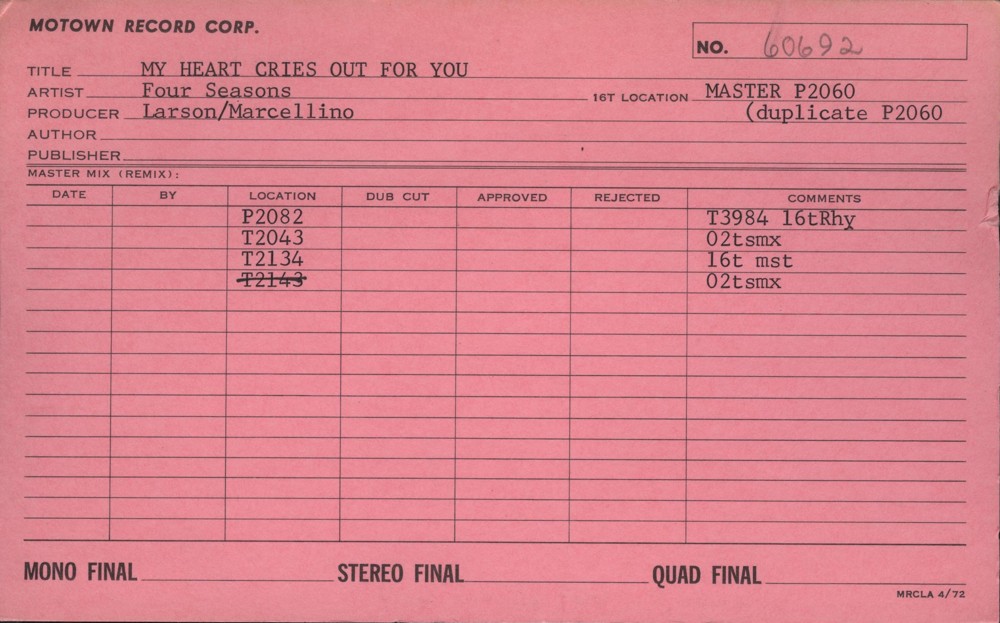 View Artists Card — view scan
Fan club president Steve Bailey got into this session at the time: “Frankie had already done lead vocal and musical tracks were finished... it is a fantastic song. Maybe the new single.” It wasn't — it stayed in the vault for nearly 50 years, finally reaching fans on the 2023 box set.
Chained
A cover of the Marvin Gaye song, written by Frank Wilson, that was the B-side of “I Heard It Through The Grapevine” in the UK and has since become a Northern Soul dance classic — a confirmed Frankie Valli version of it would be a genuine find. The Vault Manager's own tape-box review shows a possible Valli vocal/production at this point; if a vocal was recorded it would most likely be with Bob Gaudio. No Artists Card has surfaced for it yet, and it needs a P-tape listening pass.
Baby I Need Your Loving
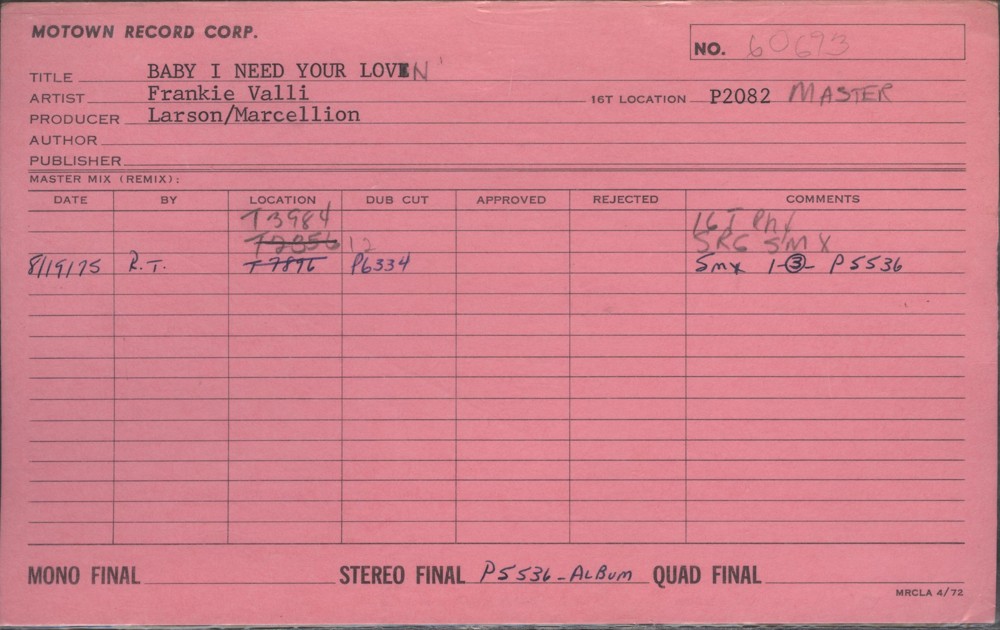 Artists Card FV001 — view scan
A Holland-Dozier-Holland cover cut in the same Lar-Mar sessions; it eventually surfaced only as an Inside You LP album track in 1975, four years after it was recorded.
I Will Love You Like A Man
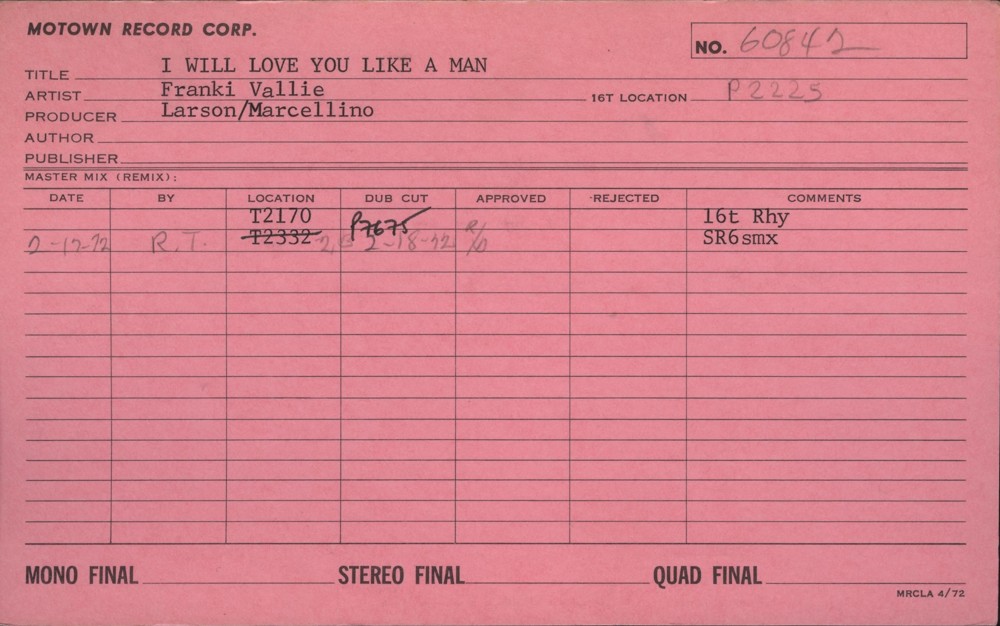 Artists Card FV004 — view scan
Found and sent to Bob Gaudio and initially approved for release in the 2023 Snapper box set — then suddenly withdrawn before the release date for reasons never explained. Possibly, though this is only a guess, connected to the gender-specific wording of the title.
Girl, Don't Take Your Love From Me
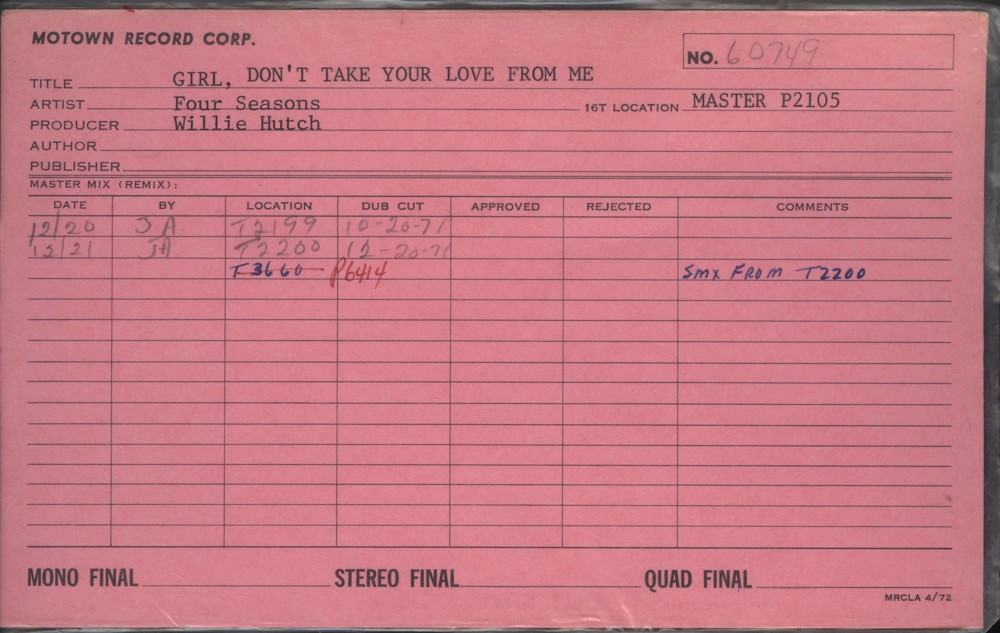 View Artists Card — view scan
The tape box itself lists two versions of the same backing track cut at this session: one assigned to the Four Seasons, one to Michael Jackson, who recorded his own vocal over the same instrumental bed the same month — it later surfaced on his Got To Be There album (1972).
What It Is, What It Is
Written and produced by Willie Hutch and recorded, in its known released form, by G.C. Cameron — later a member of the Temptations. Evidence of a separate Frankie Valli vocal is sparse; the tape indicates two Jackson 5 vocals of the same song.
Oh Girl, Everything Is Gonna Be Alright
The tape box only indicates Jackson 5 vocals (a Willie Hutch production); it's unclear whether a separate Frankie Valli vocal was also completed here. A listening test is still needed.
Thank You
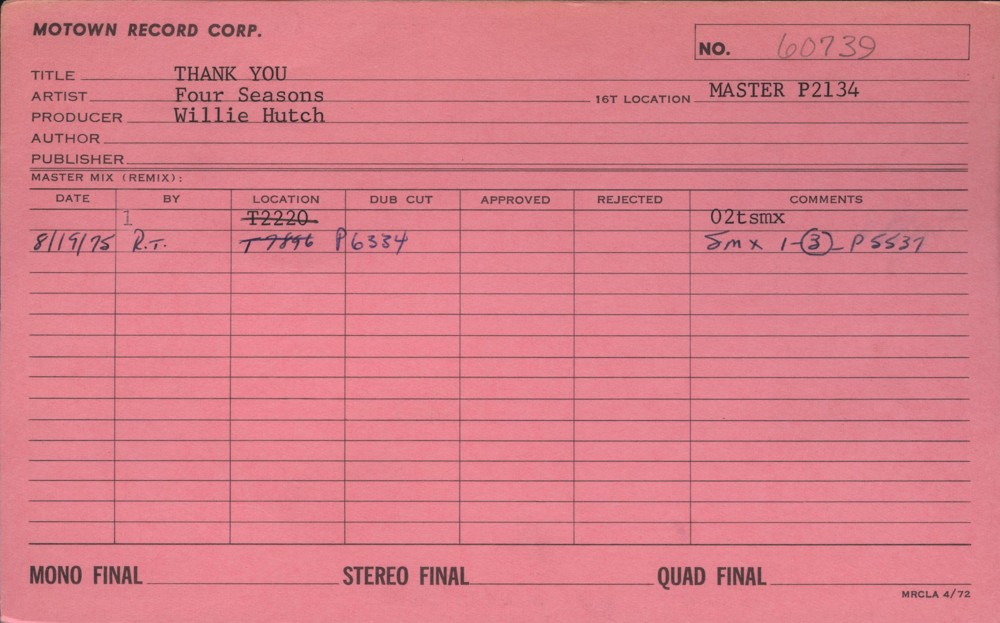 Artists Card FS009 — view scan
Cut in the same October 1971 Willie Hutch sessions as “Girl, Don't Take Your Love From Me”; the final mix used on the Inside You LP wasn't done until 19 August 1975 — one of several tracks whose original session and eventual album mix are separated by nearly four years. A later copy went to Tape P6334, matching a broader pattern of tracks copied forward specifically for the Inside You album assembly in 1975.
Where Love Ends
A mystery song on the same tape as “Thank You” — the Universal librarian's notes indicate it may possibly exist, but nothing further is confirmed.
I'll Make It Up To You
Another unknown title from the same Willie Hutch sessions — the Universal librarian's notes indicate it may possibly exist. No lead vocal has ever surfaced.
What Love Has Joined Together
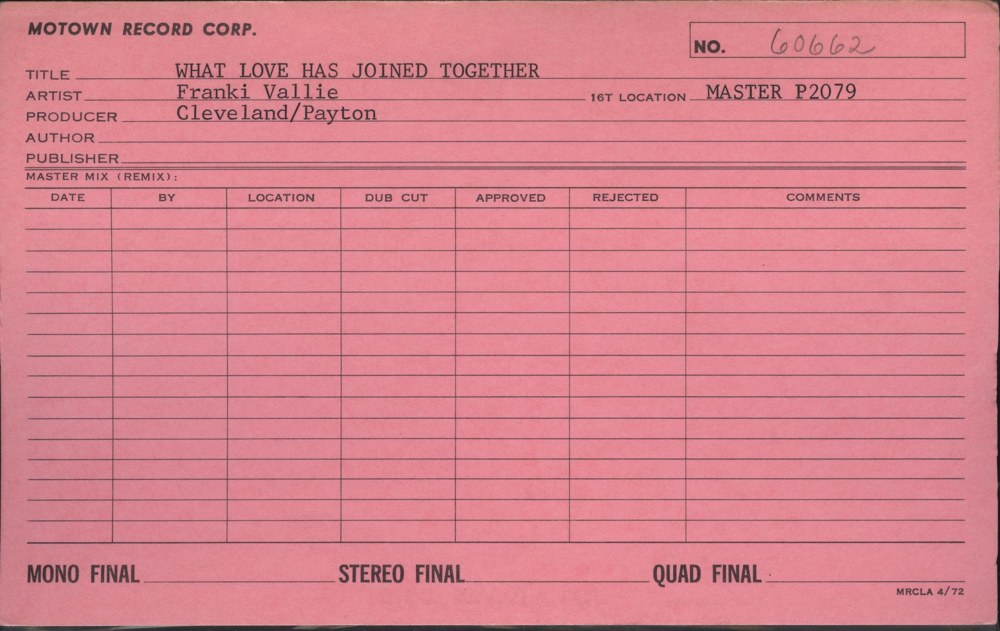 View Artists Card — view scan
A Valli cover of the Smokey Robinson song. The tape box itself was labelled “No Vocal — Assigned to The Commodores” — research in 2019 found a completed Valli vocal instead . It shows that a listening test is always needed as Tape Boxes at Motown are not ‘reliably marked’ as confirmed by CEO Harry Weinger and researcher Paul Nixon.
Save The Children
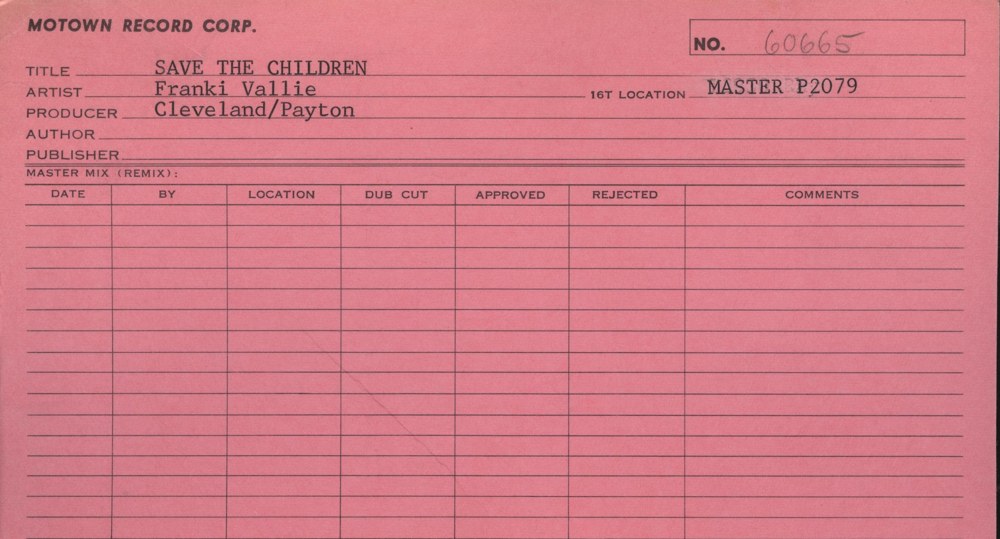 Artists Card FV008 — view scan
A cover of the Marvin Gaye “spoken lyric” song from What's Going On. The Vault Manager's tape-box review found a completed lead vocal plus two spoken narrations by Frankie Valli — a genuinely completed recording from these sessions, still unheard by the research team.
Starvin' For Your Love
A Four Tops song, logged as its own title on the same tape with no other information captured — the tape box marks it a “working vocal,” possibly a demo, still unheard. May have been copied to Bob Gaudio in 2022 by the Vault Manager.
On the other side of the same October start date, Bob Gaudio was assembling his own twelve-track album. He had a Crewe-Gaudio ballad from before their 1970 falling-out, “A New Beginning,” sitting unused as a demo; it became the album's opening prelude and returned as the full track.
Sun Country
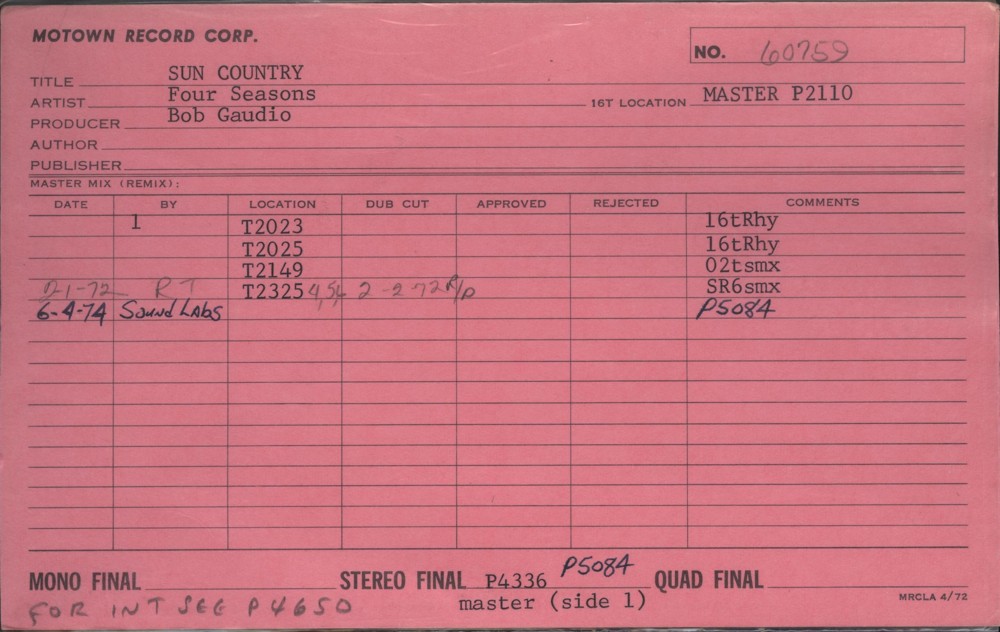 Artists Card FS008 — view scan
Cut the day after the sessions began. Selected to be the B-side of “The Night” in the US in August 1972 (MoWest 5025) but that pairing only reached a promo/test-pressing white label; it was actually issued as the B-side of “Walk On, Don't Look Back” instead, and included on the Chameleon album.
Touch The Rainchild
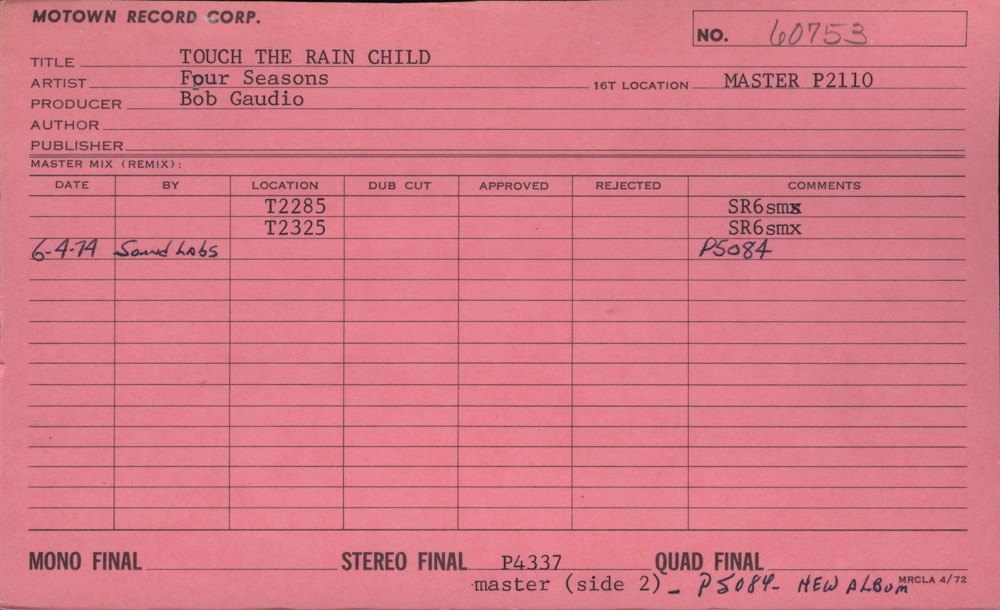 Artists Card FS011 — view scan
Included on Chameleon; also had a UK 45 issue on MoWest (MW 3028) in June 1975, b/w “Poor Fool,” and became a Northern Soul club play at Wigan Casino.
Love Isn't Here (Like It Used To Be)
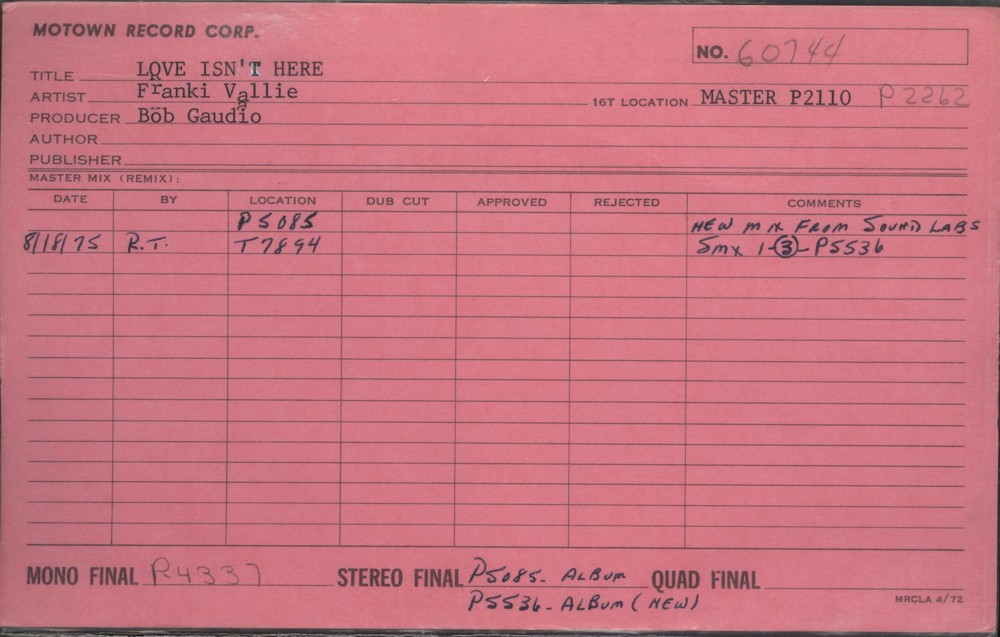 Artists Card FV006 — view scan
Issued as a Frankie Valli solo single (MoWest 5011F A, Feb 1972) with “Poor Fool” on the B-side, and included on Chameleon.
The Night
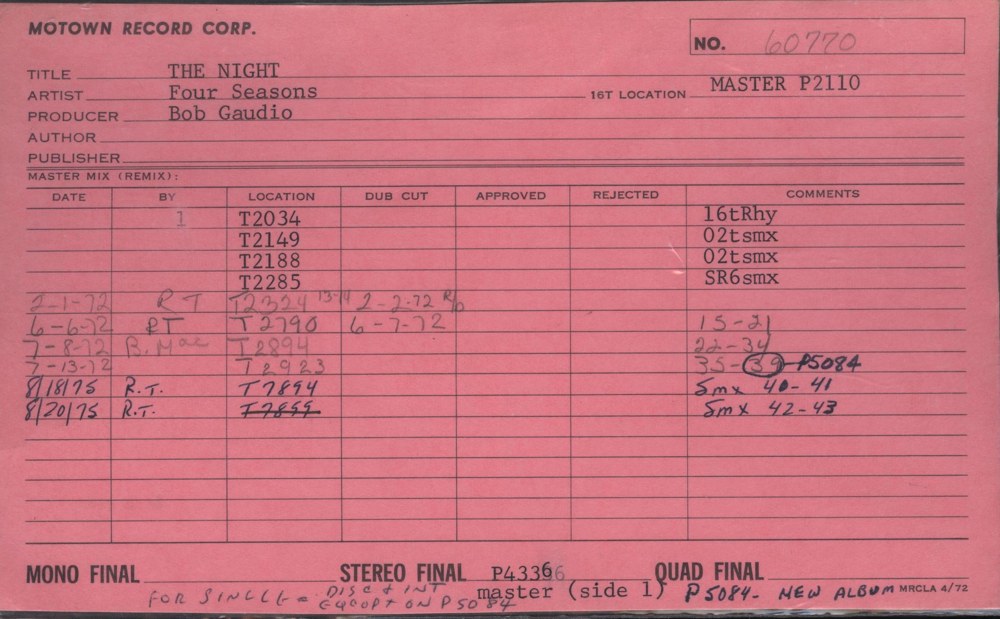 Artists Card FS007 — view scan
This one had three separate lives. A planned single pairing with “Sun Country” reached only an acetate/promo test pressing on Columbia Records Products in Santa Monica (scheduled MoWest 5025) before being cancelled. It had nonetheless been included on the original 1972 Chameleon album itself, a 3:22 edit. And the song had a key part in the group's mid-70s resurgence — It was released in the UK on the MoWest label (catalogue number MW 3002) on October 6, 1972 (b/w 'When The Morning Comes'), It gained massive popularity on the British Northern Soul club scene. This led to a successful re-release in March 1975 on MoWest (catalogue number MW 3024), which peaked at No. 7 on the UK Singles Chart. and as Russ Terrana's remix again (Mix 43, 20 Aug 1975) for the Inside You LP
Never Gonna Give My Love To You
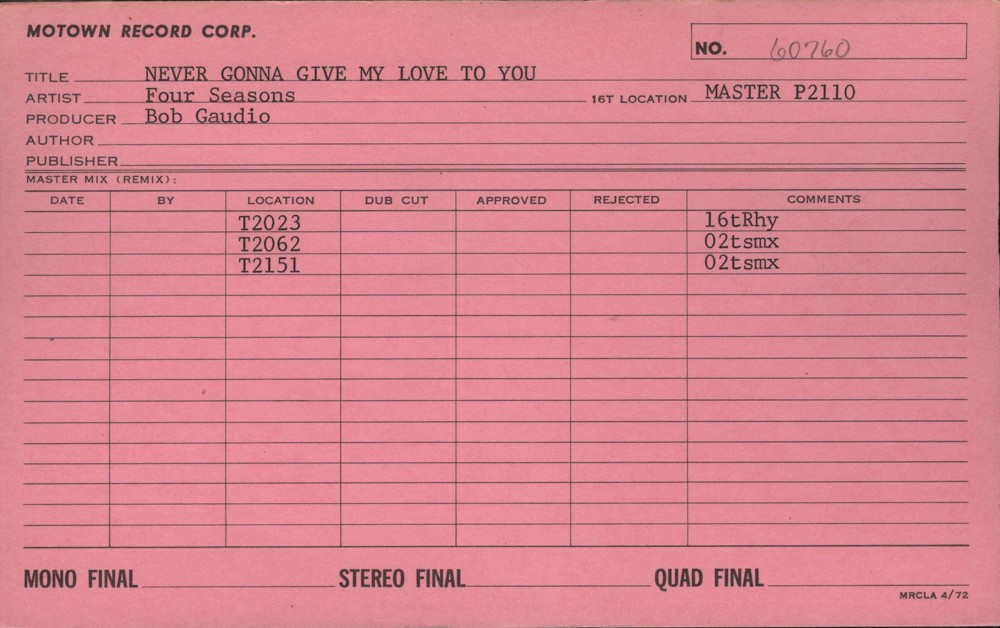 Artists Card FS007 — view scan
Never released in the period; approved for the 2023 box set alongside the rest of the unreleased Chameleon-era masters. Heavy reverb on the recent release mix differs from musicians ‘rehearsal session’ cassette version found in 2018.
When The Morning Comes
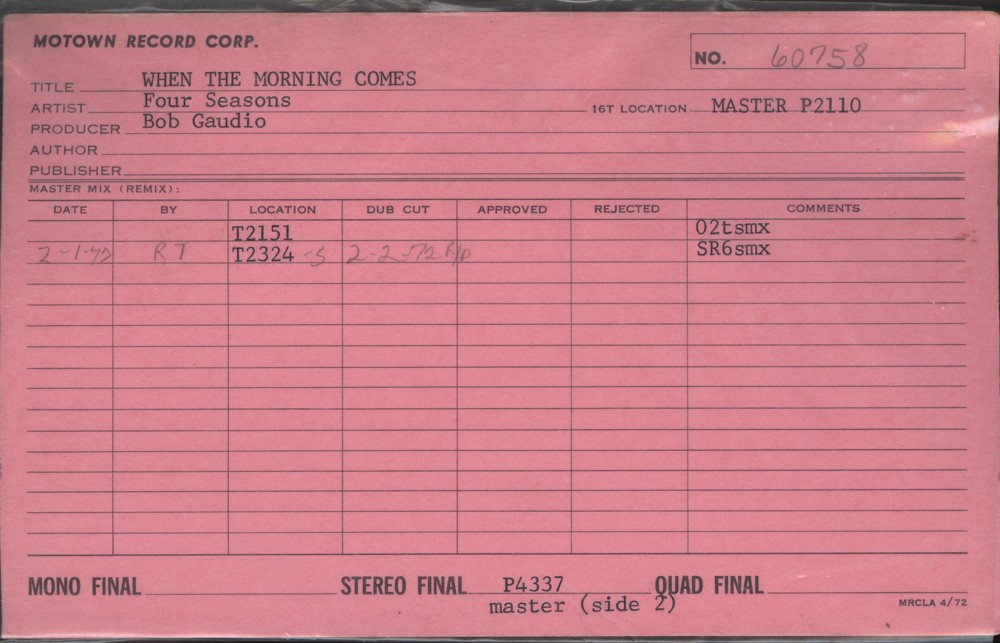 Artists Card FS012 — view scan
Included on the Chameleon album.
You're A Song (That I Can't Sing)
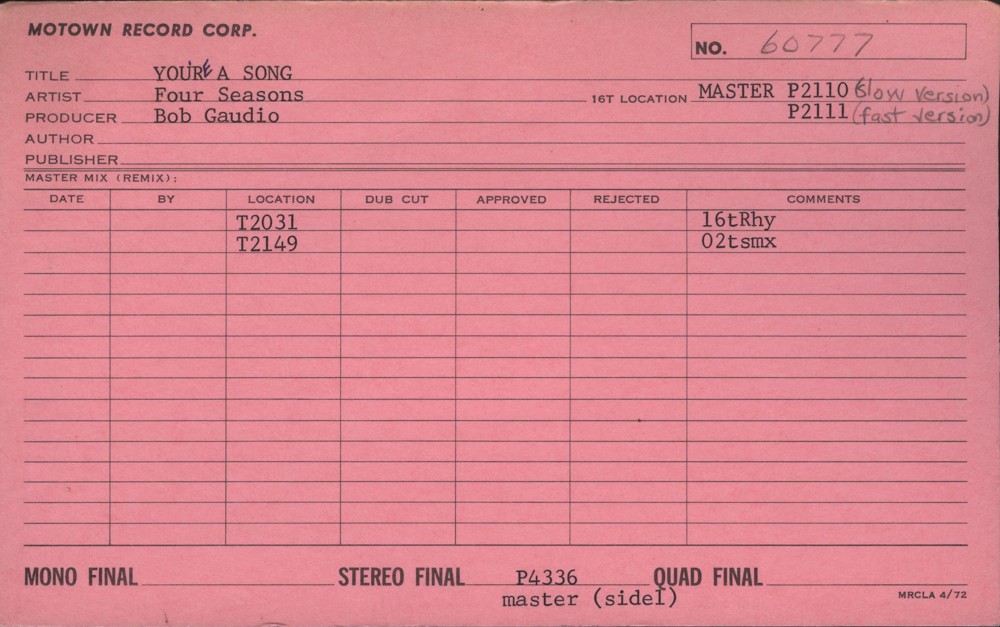 Artists Card FS014 — view scan
2022 research notes ask the open question directly: “which version is it?” A slow version sits on the same tape as “The Night”; a separate, faster arrangement ?— at least 18 takes were done — sits on the tape with “A New Beginning.” Whether the released cut is the only version that survives is still genuinely unresolved.
Poor Fool
B-side of “Love Isn't Here (Like It Used To Be),” in the US and on Chameleon.
Lovewell
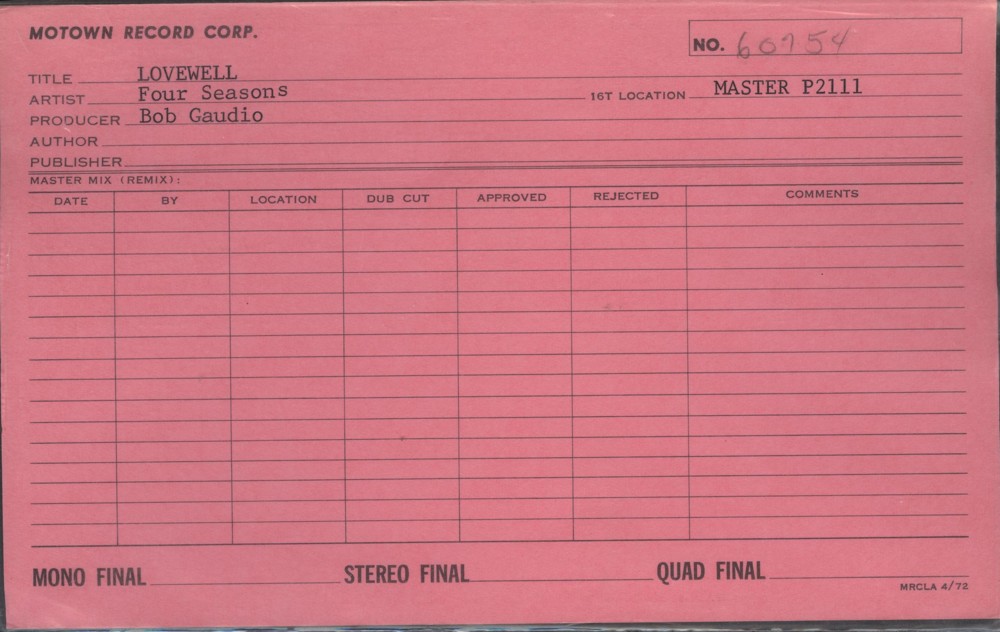 Artists Card FS005 — view scan
On the same multi-track tape as “A New Beginning.” There are notes it was worked up with vocal overdubs, and it has an Artists Card indicating completion — but no confirmed listen has yet matched it to a finished session tape.
Loving You, That's My Thing
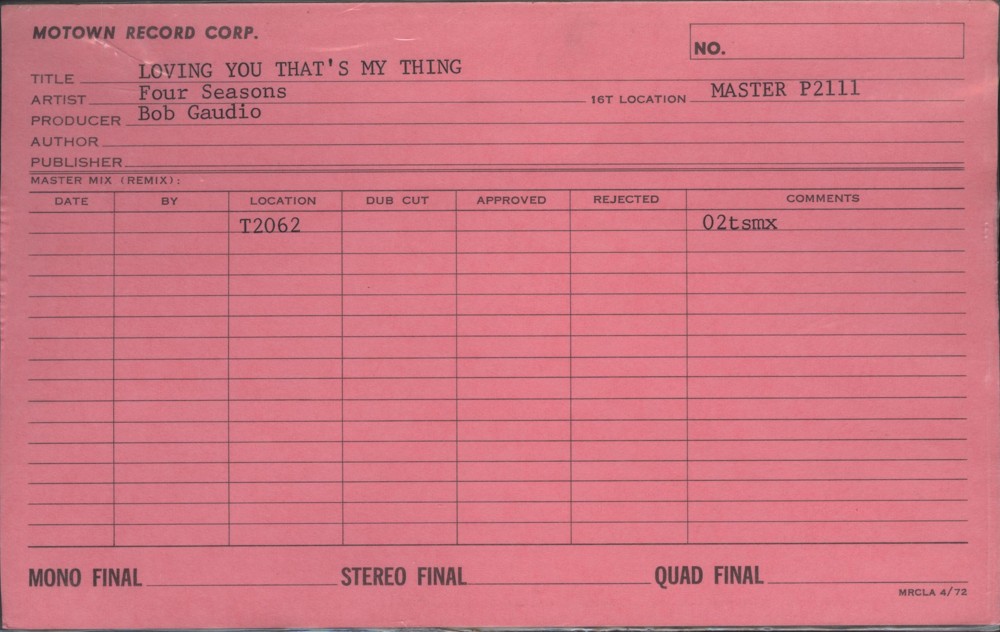 Artists Card FV008 — view scan
A mixed version has been approved and released ; earmarked for potential single release as early as a 1972 Motown Newsletter.
That's All I Want From You
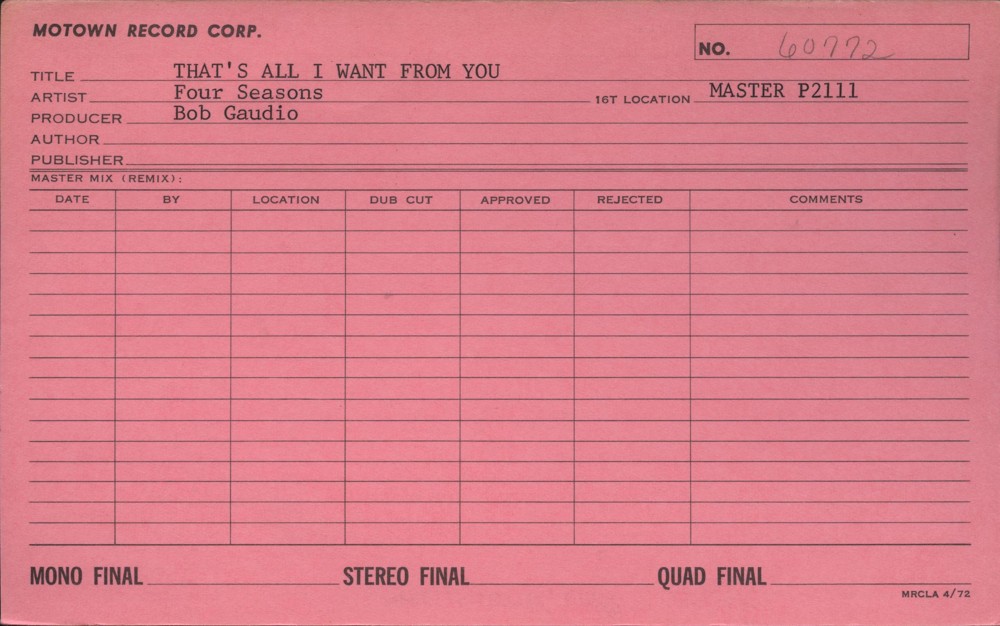 Artists Card FS009 — view scan
An instrumental version was found on a cassette copy of a musicians' session-copy of rehearsals; no vocal version has been confirmed, though the song itself clearly exists and Bob Gaudio has likely reviewed it. The title mysteriously resurfaces on a mid-70s demo tape from the early “Who Loves You” album sessions — the New Four Seasons playing the same backing track, with no lead vocal.
A New Beginning
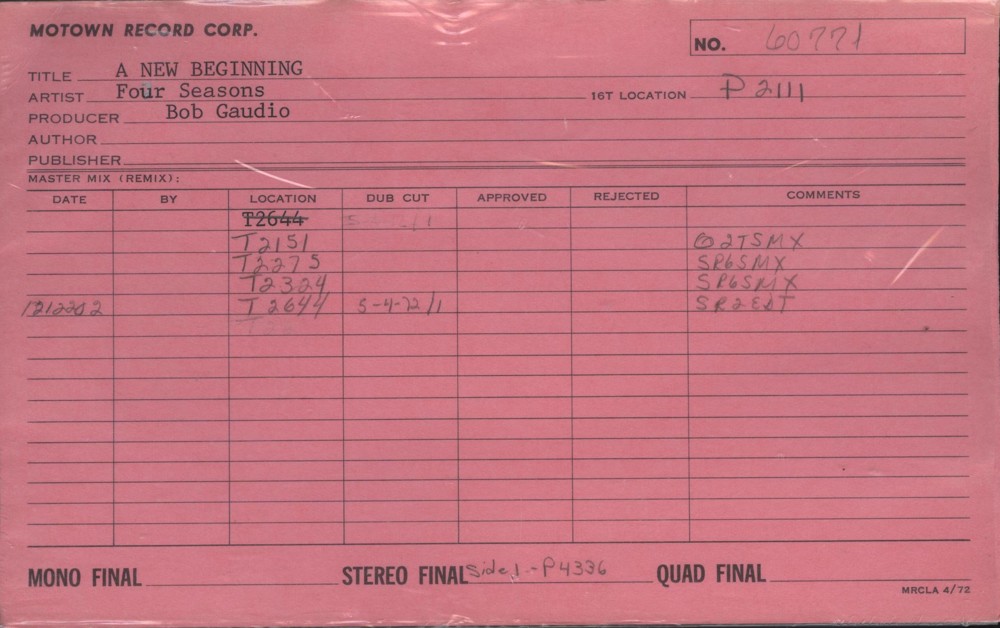 Artists Card FS001 — view scan
Opens Chameleon as “A New Beginning (Prelude)” before returning as the full version — the Crewe-Gaudio demo Gaudio had been sitting on since before their split. A separate demo of the song in a country/rock style, probably recorded up to two years before this familiar version, was found in the FSP storage.
We Had It All (Walking In The Sunshine)
Composed and first attempted right here, in the same Gaudio thread as the rest of the Chameleon-era masters — which is why the master number sits correctly in this run, not by coincidence. What happened to that 1972 attempt is still an open question: no completed vocal by the then-Four Seasons has surfaced, but whether a finished version is sitting somewhere in the Motown vaults, never traced, is genuinely unresolved. The instrumental out-take that did surface — on a 1975 rehearsal tape — is a separate matter entirely: it's a completely new, later cut by the New Four Seasons, the post-Motown “Who Loves You”-era ensemble, not a leftover from the original 1972 sessions. The theory is that Bob Gaudio liked the song enough to have his new, more capable line-up cut it fresh once he knew the original wasn't going to see release during the Motown years. It was also logged separately in a 1978/79 Warner Bros. masters listing.
Chameleon LP — MoWest 108 (MW108L), May 1972. Produced by Bob Gaudio. Arranged by Dave Blumberg, Charles Calello and Joe Scott. Recording engineers: Joe Atkinson, Larry Miles and Art Stewart. Mixing engineer: Russ Terrana.
Session Block 2 — The Corporation’s Sessions, 1971–72
Berry Gordy's own writing/production team — Gordy, Perren, Mizell, Richards
Not content to leave it all to Gaudio and the other in-house producers, Gordy put his own team, The Corporation, on the group directly. Their sessions produced a handful of tracks that never made an album — and a genuine puzzle at the centre of the Tape Index.
Walk On, Don't Look Back
However, deep-dive discographical research into Motown's session logs—notably compiled from original artist cards and tape indices in Reginald J. Bartlette's archival reference work Off The Records: Motown By Master Number 1959-1989—revealed a systemic clerical quirk: matrix number 60516 was allocated twice.
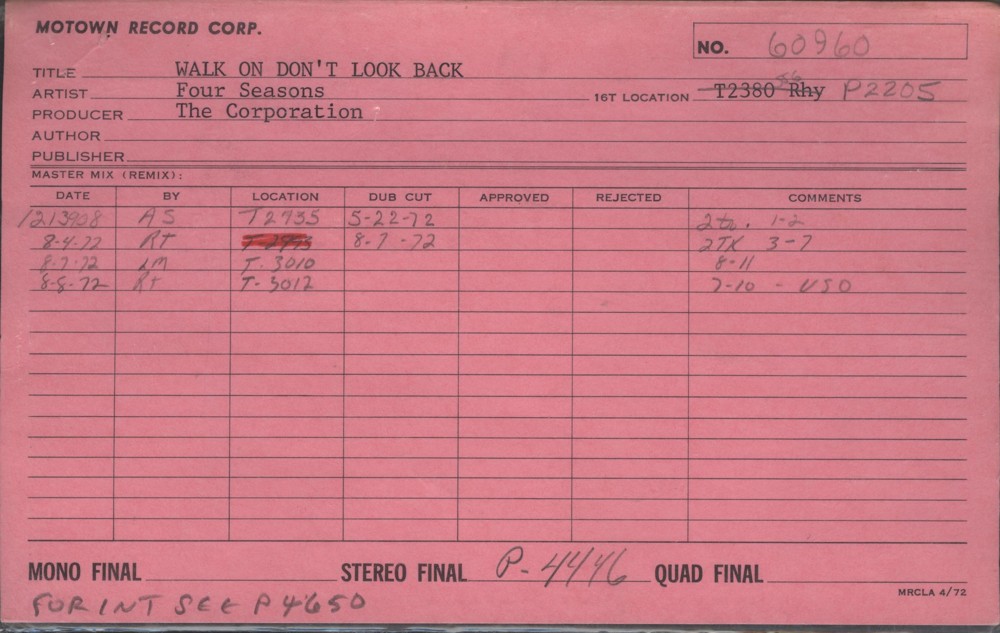 Artists Card FS012 — view scan
Written to mimic the group's own mid-60s sound exactly, it landed in a 1972 market that had moved on — and only found its audience three years later, on the Northern Soul scene at Wigan Casino. First mix by Russ Terrana, 4 August 1972; issued MoWest 5026F A, August 1972, with “Sun Country” on the flip.
After I'm Gone
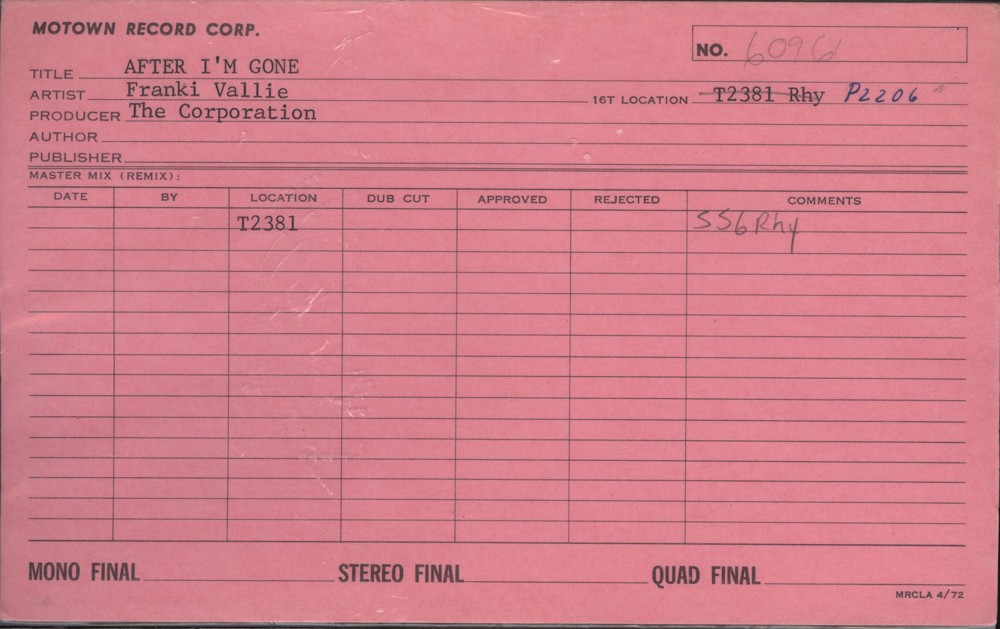 Artists Card FV001 — view scan
A Master Number in the official Motown Master records indicates a completed recording by the group with the Motown production team.
Time Will Tell
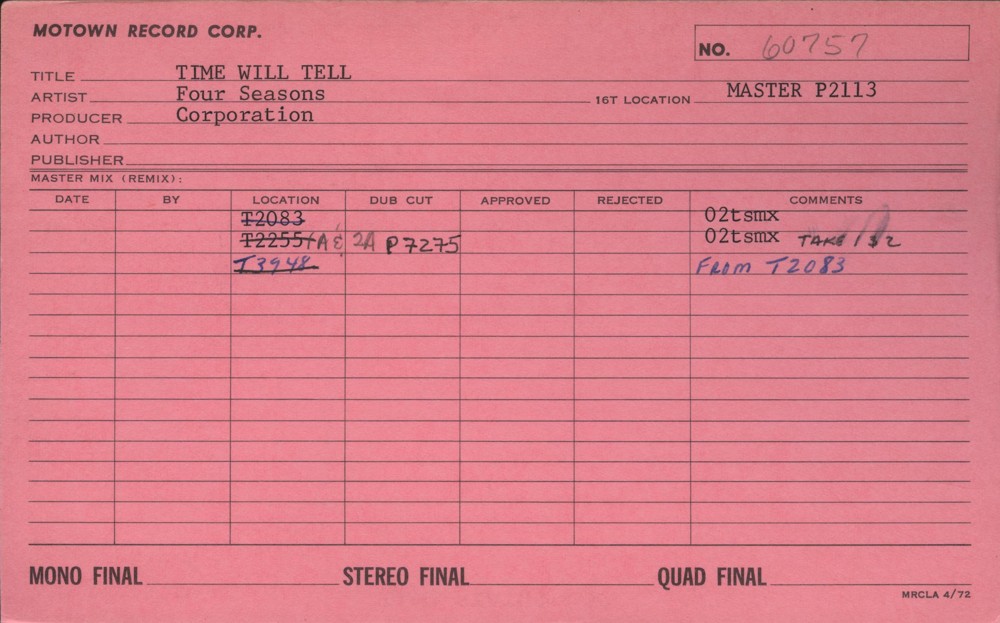 Artists Card FS010 — view scan
A clear melodic evolution of “Can't Take My Eyes Off You,” recorded and released by the soul group Second Nature in 1972, produced by Bob Crewe, on Bell Records (Bell 45179). Almost certainly sent on to Bob Gaudio at some point.
Wigs and Lashes
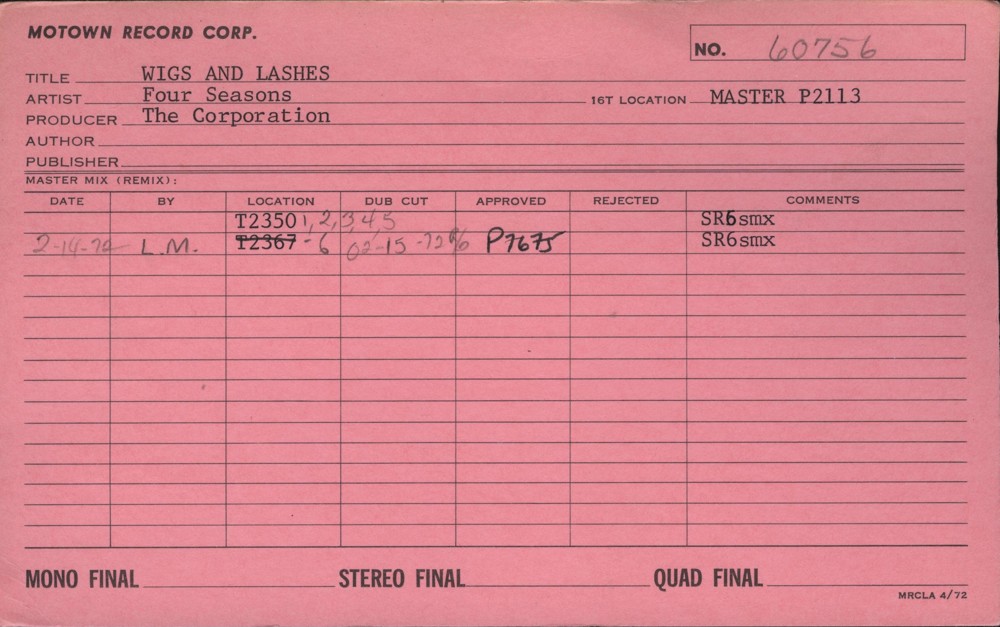 Artists Card FS013 — view scan
A version by the Miracles was released — reportedly on their Renaissance album (1973). The tape box indicates a possible Four Seasons version too, and its own Artists Card confirms one was recorded — probably held with Bob Gaudio.
Coming Home
No surviving Artists Card at all — known only because Motown's internal records list a completed master number, which itself suggests a high probability of a completed vocal. The same recording was later released as “Coming Home” by Michael Jackson.
Live It Up
Same situation as “Coming Home” above: no Artists Card, known only from the internal master list. The fact a master number was allocated suggests a Frankie Valli version probably does exist, possibly held with Bob Gaudio. The same recording was later released as “Live It Up” by Jermaine Jackson.
Session Block 3 — Late 1971 to December 1972: Chasing A Solo Sound
Frankie Valli, various producers — Hal Davis, Willie Hutch, Michael Masser
Record-keeping for this stretch is thinner than anywhere else in the Index — but the master numbers that were assigned tell their own story: Motown kept trying, one producer at a time, to find Valli a solo hit outside the group album.
Just Look What You Have Done
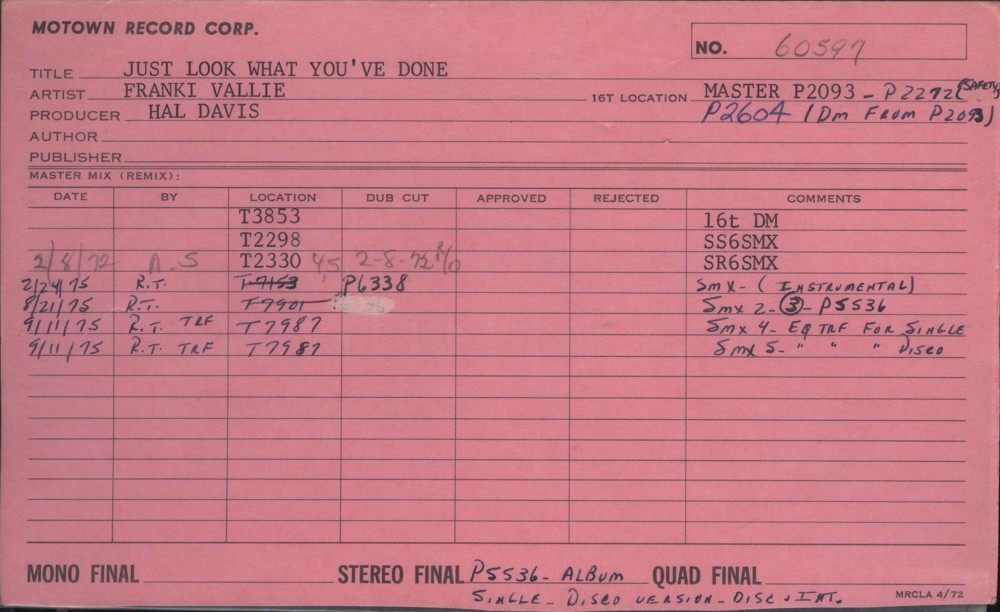 Artists Card FV005 — view scan
Originally a Brenda Holloway single (1968) — Hal Davis's production was unheard for 4 years and was so ahead of its time. Hal reworks it as an uptempo, disco-styled cover, one that later became a dance-scene favourite in its own right. It opens the Inside You LP in 1975, and a promotional 12″ single supporting that album followed with a special Dance Mix — confirmed against Discogs and BSNPubs as Motown PR-10, 12″, 33⅓ rpm, a double-A-sided "for Disco DJs only" pressing, 1975 (matrix 60597-S — the same master number, so this is the same recording, just remixed/repurposed for the club promo). That confirms this was a single release, not two separate 10-inch and 12-inch pressings. The trail continued once more the following year, with a commercial 7″ single on Tamla Motown/EMI Electrola in Germany (1976), pairing it with "Thank You" on the B-side. Four or five different moments across five years for one recording.
Life and Breath
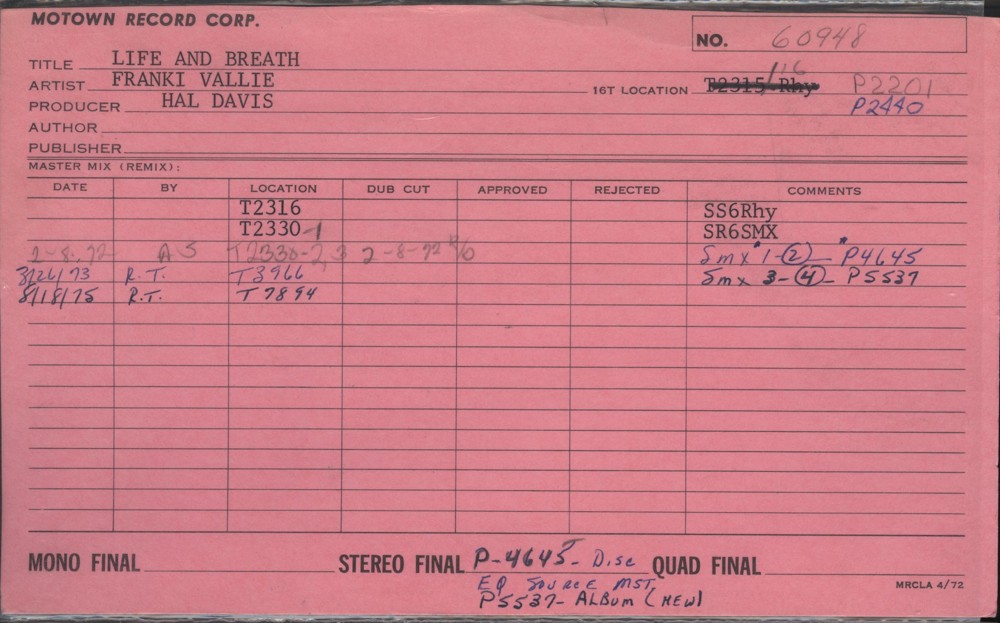 Artists Card FV005 — view scan
First mix Feb 1973, a further mix by Russ Terrana March 1973, and a final remix in August 1975 for the Inside You LP — issued as the B-side of “How Come,” Motown 1255F B, May 1973.The single version has the Four Seasons whisper and intro, the later versions do not.
Stop, Look And Listen To Your Heart
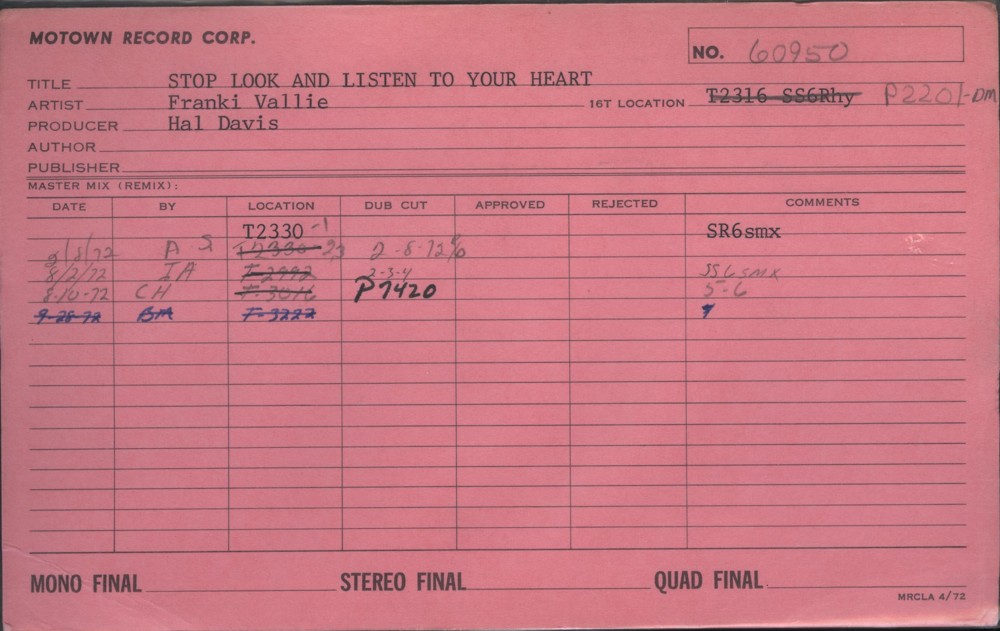 Artists Card FV009 — view scan
Final mix 10 Aug 1972. The same backing track was later used for Diana Ross and Marvin Gaye, issued on their 1973 album Diana & Marvin — the Valli vocal itself stayed unreleased until 2023, and arguably stands as the definitive version of the song, alongside the original recording made famous by The Stylistics in 1971, written by Thom Bell and Linda Creed.
Thank You For Yesterday
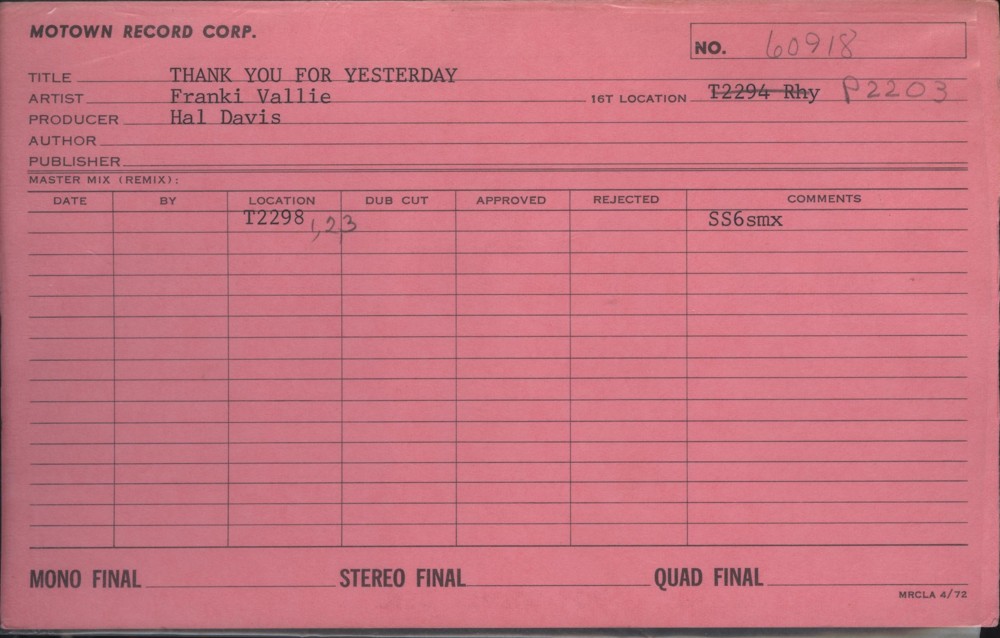 Artists Card FV010 — view scan
A lead vocal was found by the Vault Manager's tape search; a copy of the full mix is probably with Bob Gaudio.
Torn Between Two Lovers
Reputedly written by G.C. Cameron and assigned to him — there's no confirmed evidence of a Frankie Valli vocal here unless a listening test has revealed one.
Include Me In Your Life
The tape box itself reads “Reassigned to Suzie Ikeda / Suzie vocals / Also Ross/Gaye” — yet a 1990s internal Universal list separately records it as a Frankie Valli recording. Still an open question, not a closed one.
Point Of No Return
Originally recorded by The Stylistics (1973); a Frankie Valli cover, if it exists, would be on this tape. A listening test is needed.
Sitting On The Edge Of My Mind
This distinctive title appears in the BMI listing as a Fletcher-Gana-Matheney song. Its known released version opens the second solo Jermaine Jackson album (Motown, May 1973), also a Hal Davis production — which makes a matching Valli version plausible, but no master number was ever allocated to confirm it, and only the tape itself can settle the question.
When I Come Of Age
A Fletcher-Davis-Parks song, written specifically for a young Michael Jackson — any Frankie Valli vocal on this tape would be a demo.
Minute By Minute, Day By Day
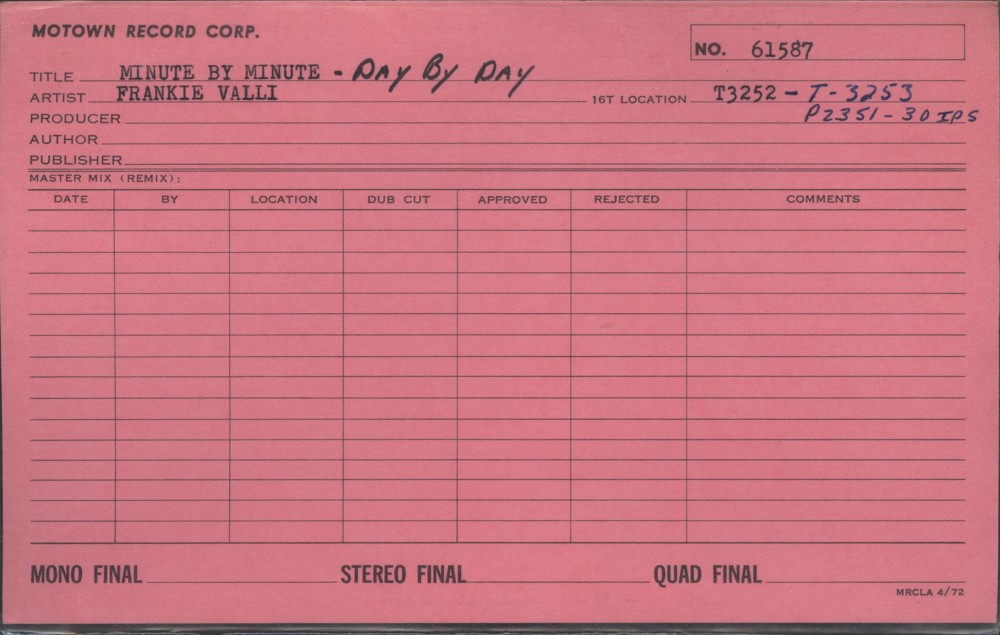 Artists Card FV007 — view scan
Both this and “After You” were on the Vault Manager's 2019 “still to come in, with possible vocals” list — the lower-confidence tier, not the confirmed nineteen. Both turned out to exist and were approved for the 2023 box set: proof that the “maybe” tier of the first review was not a reliable predictor of what was actually there.
After You
A Ron Miller/Michael Masser song; a different arrangement was later recorded by Diana Ross and released in 1974. This Frankie Valli master has been found, mixed down, and approved for release. It is a much more 'male focussed' emotional rendering than Diana's.
I Can't Get Away From You (But I Can't Get Over You)
This song was also released under a different artist credit — Tony & Carolyn, on the Motown/VIP subsidiary label, VIP 25068, November 1971. Written by Pam Sawyer and Michael Masser, so a Frankie Valli version perhaps exists…….. but is it by Crewe or Masser and from the same October 1972 Masser sessions, on Tape P2351 or P2352. As the Master number follows his recording of ‘Minute By Minute’ [Master61587] ‘the jury is out’ on this one at the moment
With You
Carrying a master number, this probably exists. If it's the same song, the writers are Carole Bayer Sager and Ken Ascher, and the title was eventually re-recorded and released on Lady Put The Light Out in 1977, on Private Stock — it isn't yet confirmed whether that release drew on this same song and if the ‘probably recorded’ version still exists at Motown.
Session Block 4 — January 1973: Crewe and Gaudio Reunite
Back on the main Motown label, as MoWest wound down
By November 1972, with MoWest unravelling, Bob Crewe was back in the studio with Frankie Valli for the first time in years. Weeks later, Crewe and Gaudio were writing and producing together again, for the first time since their 1970 falling out.
Be My Lover, Be My Friend
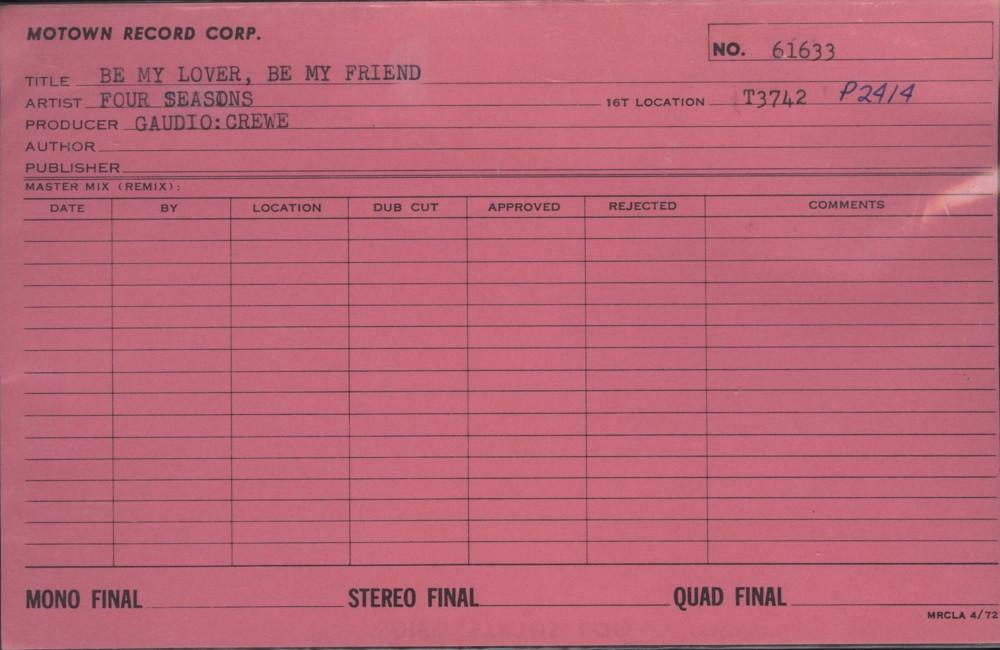 Artists Card FS001 — view scan
Crewe's first listed and completed Motown master, written with Ellie Greenwich and former Four Evers singer Steve Tudanger. No evidence yet of a tape check, or of the master being sent to Bob Gaudio — it remains unreleased.
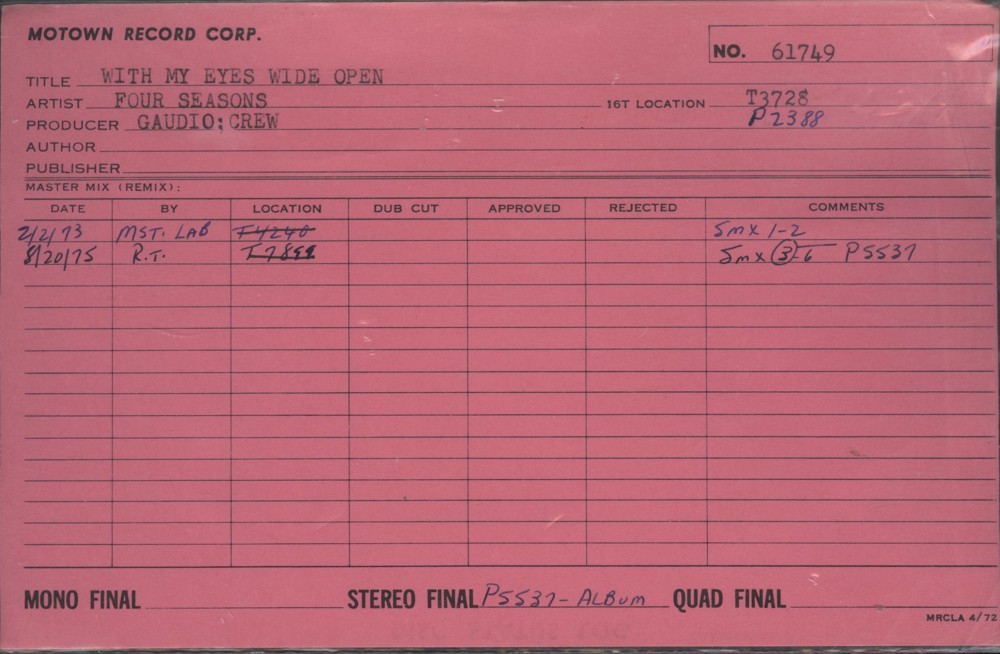
With My Eyes Wide Open
 Artists Card FS013 — view scan
Surprisingly listed as existing on three separate production/session tapes. An anthemic song that should have interested Motown's own executives. It didn't get a single release — the original February 1973 mix can still be heard, separately from what Motown did with it in 1975; see the Later Life note below.
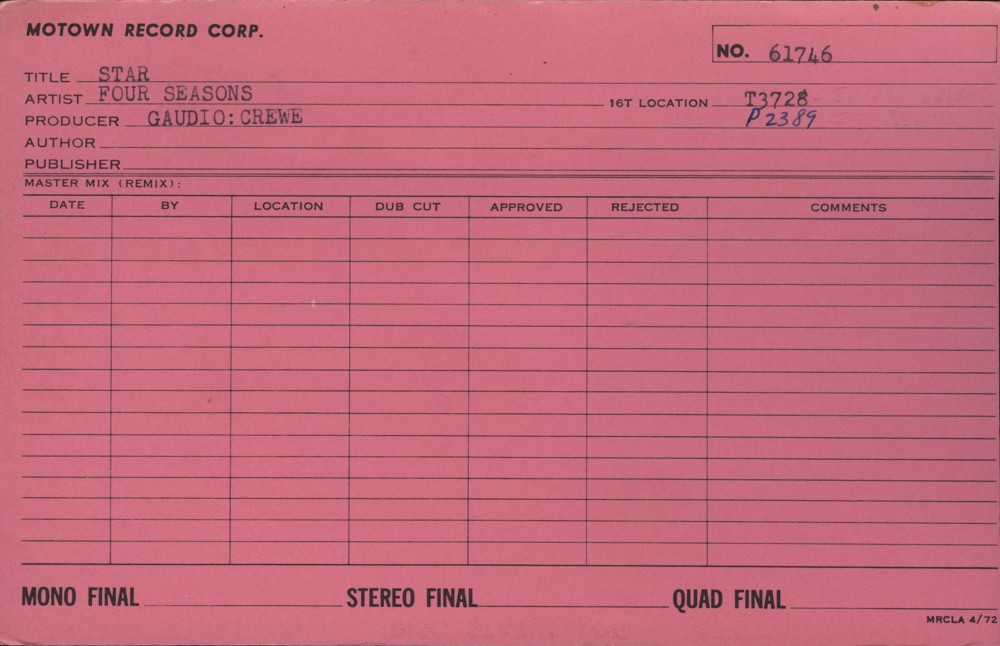
Star
 Artists Card FS008 — view scan
The one track from this whole period Snapper was actually shown a Motown tape-box scan for, released to the box-set research team — sitting on the same box as “With My Eyes Wide Open” and “Listen To Yesterday” (Tape T3728, an unregistered tape copy per the Artists Card). A driving rock vocal drops into a slow, falsetto-soaked Seasons harmony ballad — “totally original” for its time. Found on the 16-track master tape, mixed by Bob Gaudio, and approved for release.
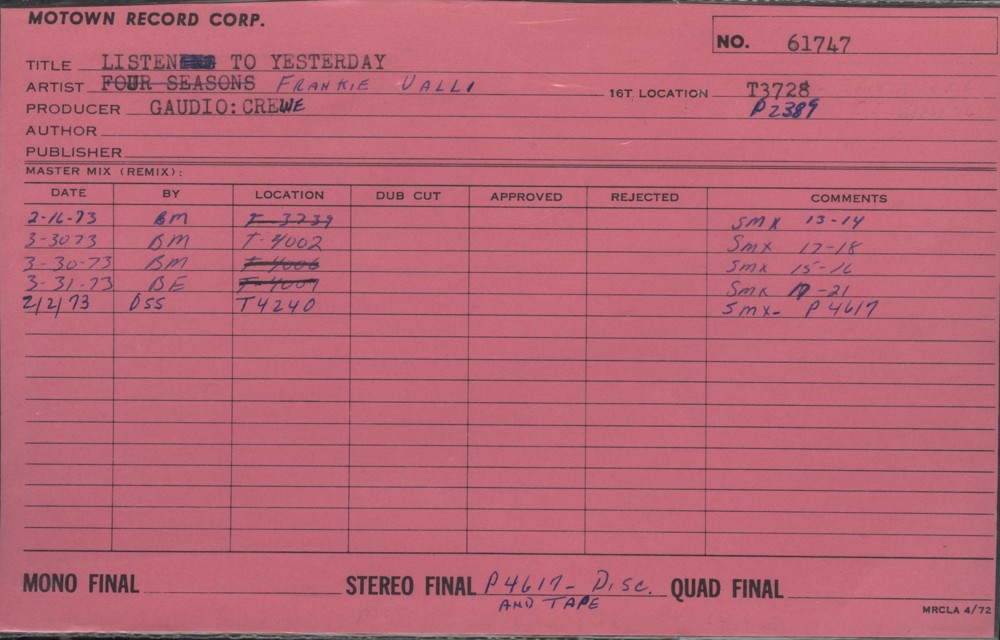
Listen To Yesterday
 Artists Card FV006 — view scan
Issued as the B-side of “You've Got Your Troubles” in May 1973, then again backing “The Scalawag Song” in November 1973 — the single versions feature female backing vocalists. A separate alternate version, found in the FSP storage with a surf-sound intro and Beach Boys-style harmony, also surfaced on the 2008 Anthology CD — a set that was supposed to include no unreleased material at all.
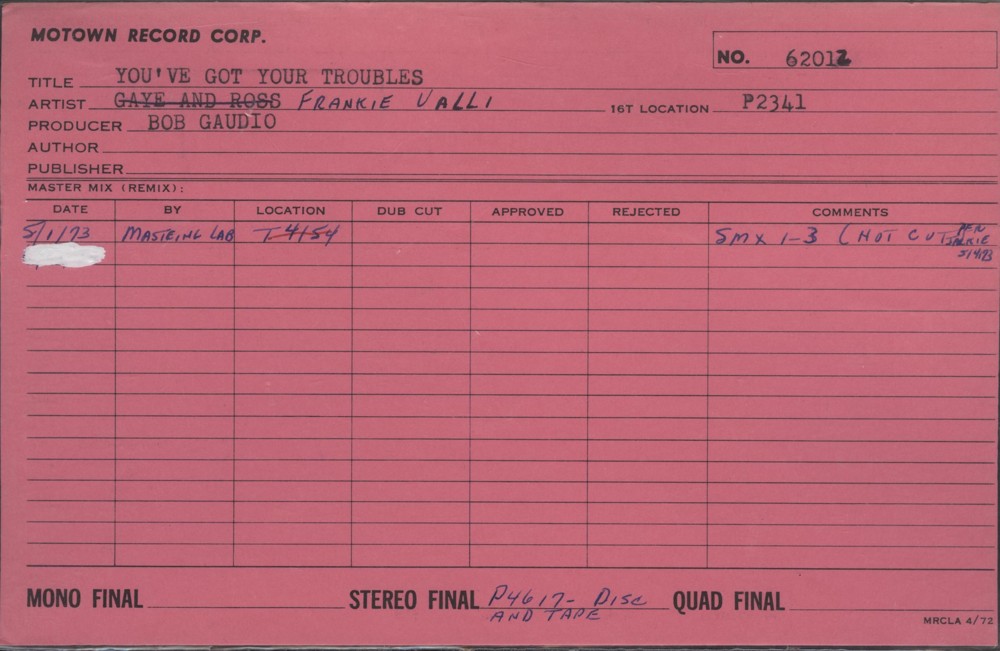
You've Got Your Troubles
 Artists Card FV012 — view scan
A cover, of the Roger Greenaway/Roger Cooke song by The Fortunes and again repeated by Gaudio and Crewe together — issued as a non-LP single, Motown 1251 A, May 1973. Produced again in a slow and morose rework of a version already issued on Philips in 1969.
Inside You
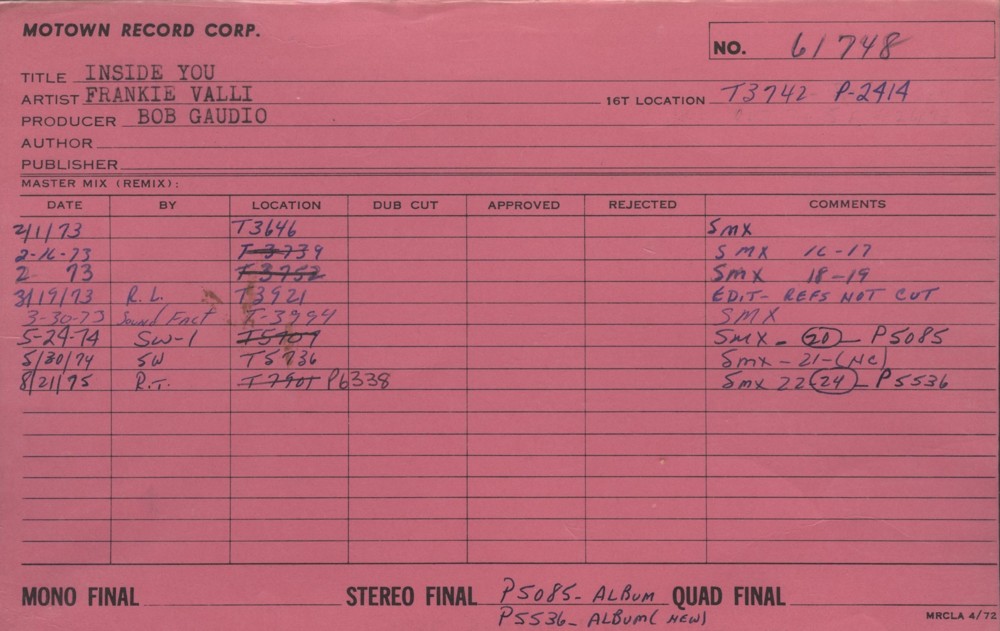 Artists Card FV004 — view scan
The song that eventually gave the whole belated 1975 album its title — written and first mixed in these February 1973 sessions, two and a half years before it reached a shop. See the Albums & Lost Albums section for the full story of how that record came together.
“With My Eyes Wide Open” was still unreleased when the group left Motown. It sat untouched until Motown, cashing in on “My Eyes Adored You” and the UK success of “The Night,” pulled it back out for the belated Inside You album in 1975. The engineer this time was Russ Terrana — who'd also mixed Chameleon — and on 20 August 1975, nearly a year after the group had gone, he remixed the track with added reverb and echo. Bob Gaudio said afterward he'd had no input into that album's final mixes, and was very unhappy with its release in this mix. That version is the clearest case of what he meant: the track Terrana turned in was completely different from the one Gaudio and Crewe intended, its ‘rock’ theme distorted by the added effects.
Session Block 5 — Spring 1973: How Come, and Frankie Without The Group
The group briefly disbanded; Motown session singers stand in
By March 1973 the group had genuinely fallen apart — Frankie Valli sacked the line-up after a backstage blow-up in New Jersey. With no settled group to fill the booked sessions, Crewe brought in session singers to complete the tracks, preserving the harmony sound around him. “How Come” (written for the film Tom Sawyer, though not used on the actual soundtrack) became the resulting single — Gaudio doing the vocal arrangements, David Blumberg the orchestral arrangement, Crewe producing, with Motown session musicians standing in for the group — Motown's last real push for a hit before the label lost confidence and shelved the planned second album (see Albums & Lost Albums).
How Come
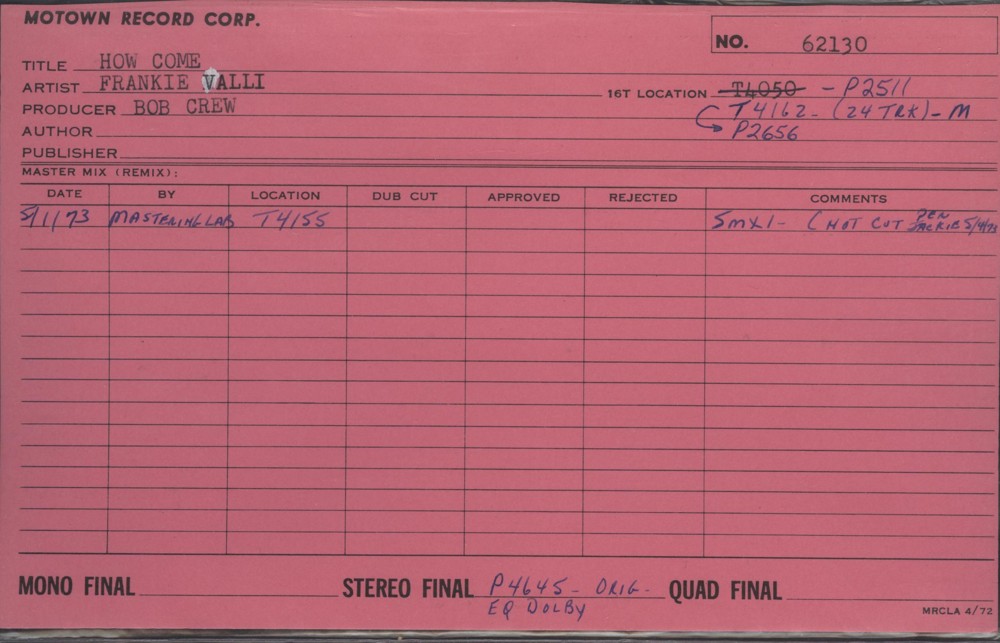 Artists Card FV003 — view scan
Issued as a non-LP single, Motown 1255F A, May 1973 — a Sherman Brothers song, written for the film Tom Sawyer but not used on its actual soundtrack.
Turn It All Around
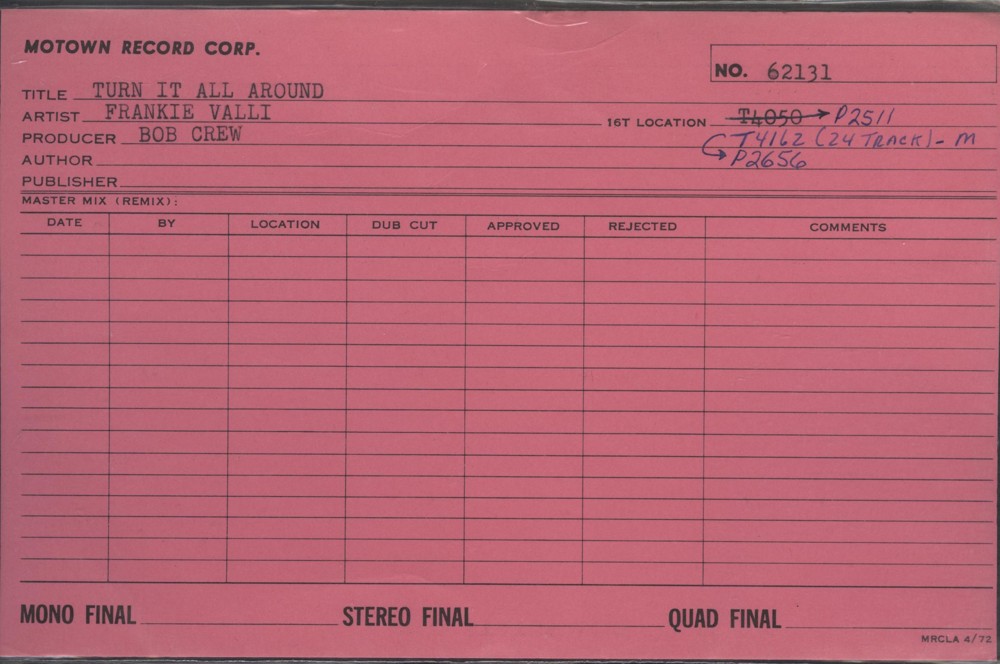 Artists Card FV010 — view scan
Recorded at the same April 1973 sessions as “How Come,” and copied to two separate tapes (P2511, then 24-track P2656) — which should have made it easy to trace and clear. The tape box lists only a demo/work vocal. It's never been explained as “not up to standard”; it simply remains unreleased.
Give Us This Day
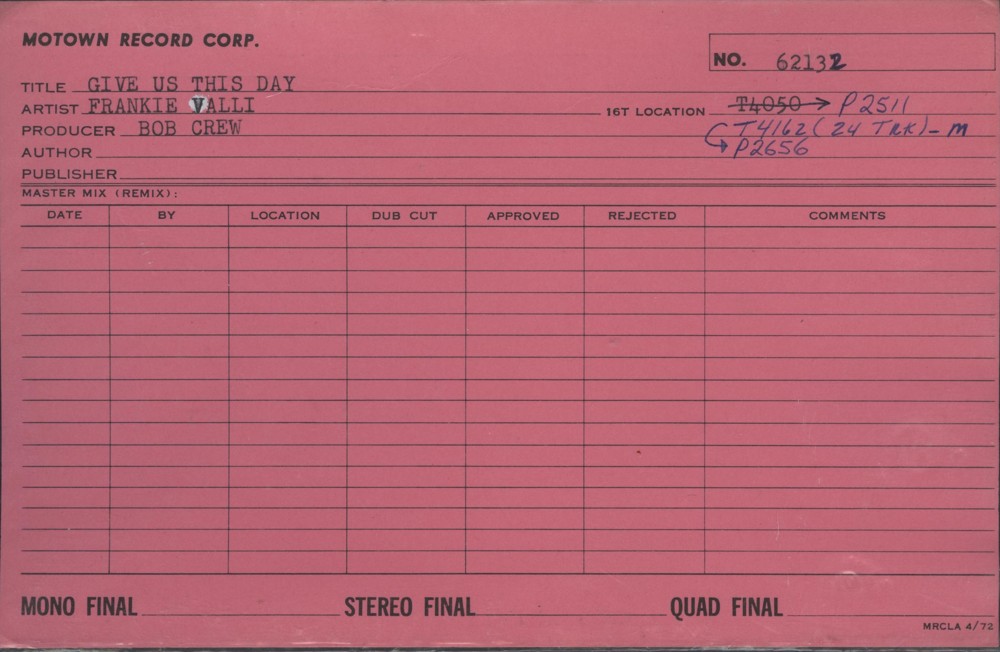 Artists Card FV003 — view scan
Same session, same story as “Turn It All Around” — unreleased, and not otherwise explained.
I Heard A Love Song (But You Never Made A Sound)
Recorded by Diana Ross in August 1973, with Motown ‘interns’ indicating Frankie Valli had also recorded it — possibly a vocal attempt made the same month as the Ross version. Composer/Producer: Bob Gaudio. Lyricist: Bob Gaudio & Brit Gaudio.
Session Block 6 — Mid-1973: Bob Gaudio’s Own Solo Push
Tape P2505 / P2678, May to October 1973
With the group's contract running out, Gaudio made one more attempt at a Valli solo hit. Only “The Scalawag Song” reached release; the rest of this run stayed in the vault.
The Scalawag Song (And I Will Love You)
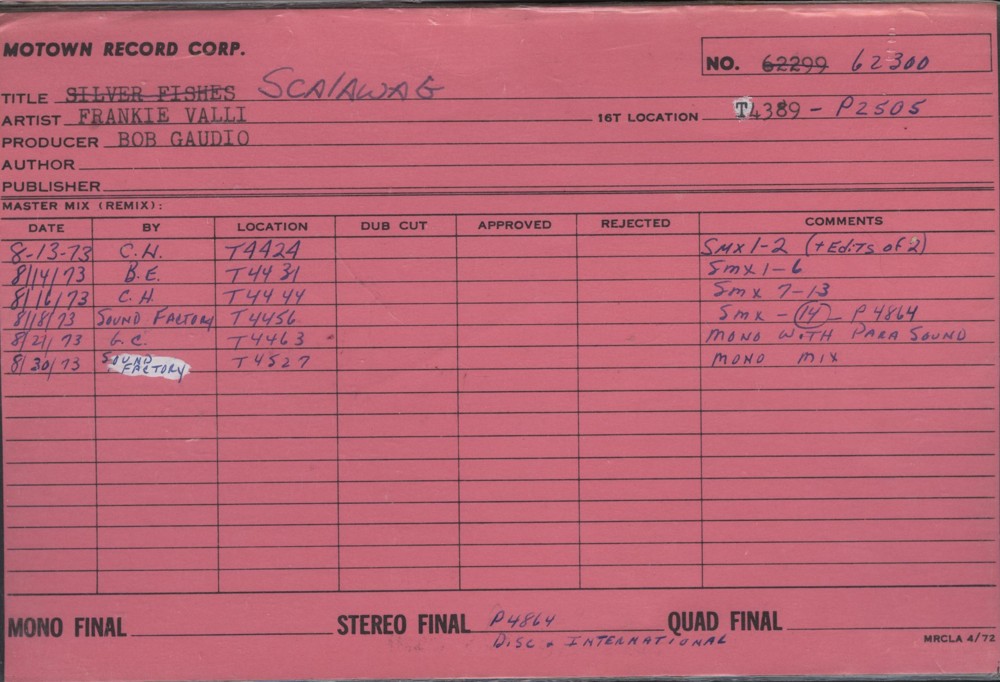 Artists Card FV009 — view scan
Issued as a non-LP single, Motown 1279F A, October 1973 (14 documented mixes of this edit), and included on the UK version of Inside You.
You Can't Hold On
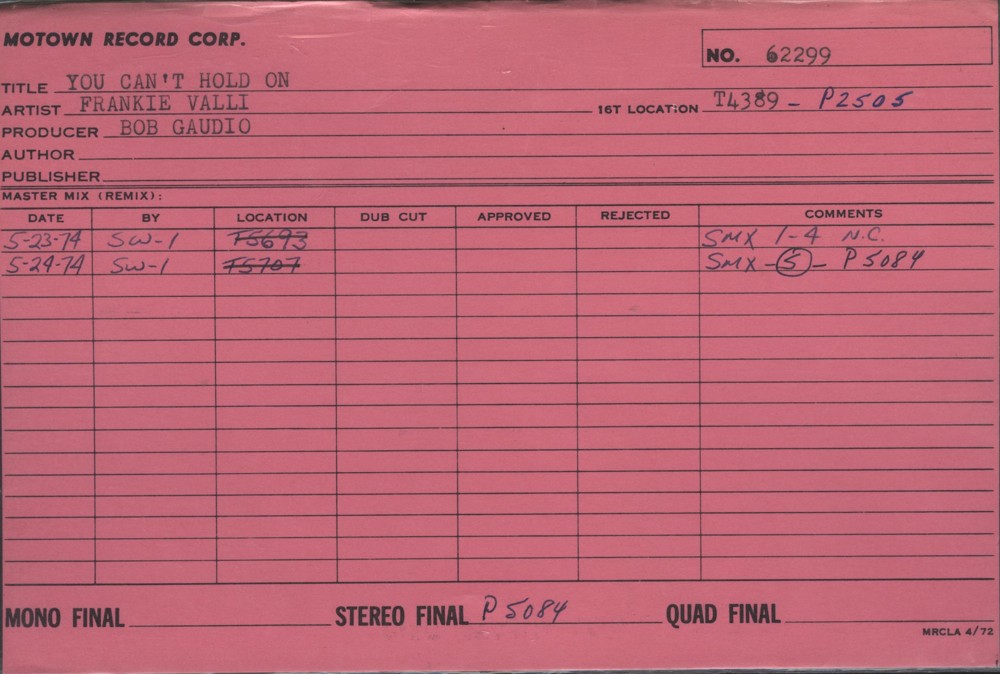 Artists Card FV009 — view scan
Recorded July 1973; first five mixes made 24–25 May 1974 for a planned 45 and album release that never happened. Writers not declared, credited to Copyright Control. Found, mixed, and approved for release. Possibly written by Tony Martin Jr. and Guy Finley who Bob Gaudio was also producing at the time.
Future Years
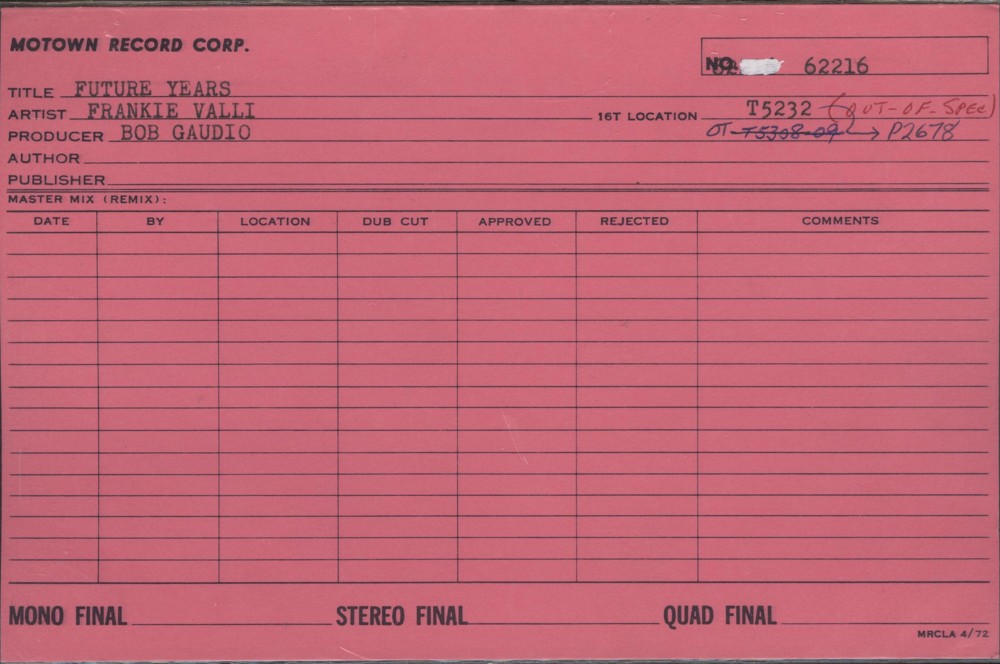 Artists Card FV002 — view scan
Copied in May 1974 for the same planned, cancelled album release as many other tracks. The Vault Manager's/Bob Gaudio approved mix and the alternates found in the Four Seasons Partnership's own LA storage aren't the same recordings — the FSP copies have either a different ending or different instrumentation and vocals; all versions have their admirers. The alternate mix was added as a bonus track on the 2023 box set's unreleased disc.
Whatever You Want
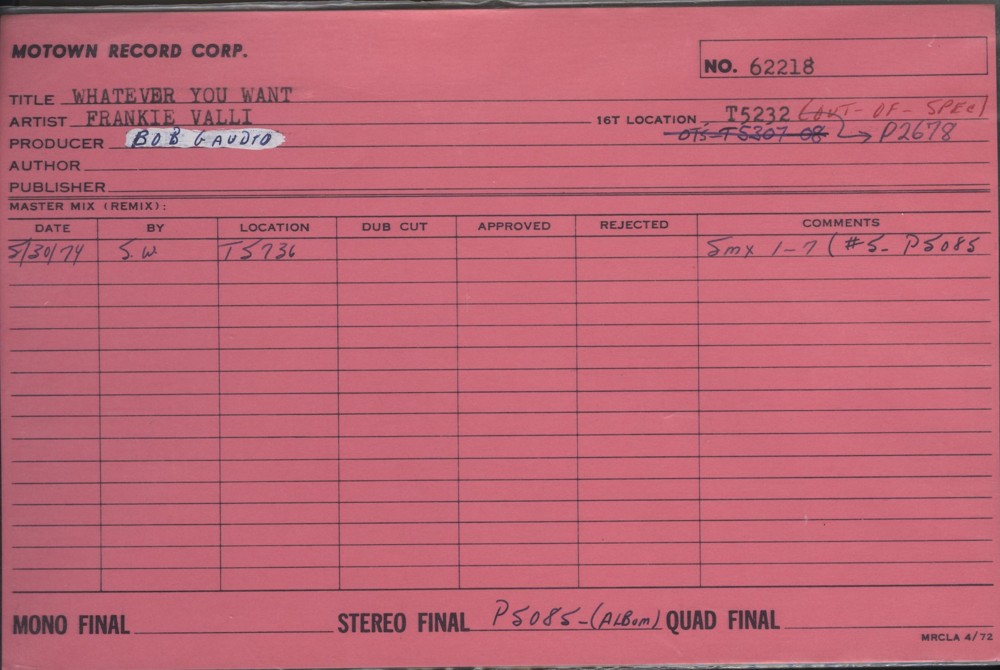 Artists Card FV013 — view scan
A remake of a 1961 Crewe-Gaudio song originally recorded and released with Jerry Butler and recorded in May 1974 it would be ear-marked for the same cancelled-album fate as “Future Years” and “You Can't Hold On.” The FSP storage copy is again a different take — an underdub, piano-only and Frankie Valli vocal version against the Motown vault mix Gaudio reviewed in 2019. Found, remixed, and approved for release in 2023; also.
Getting Over You
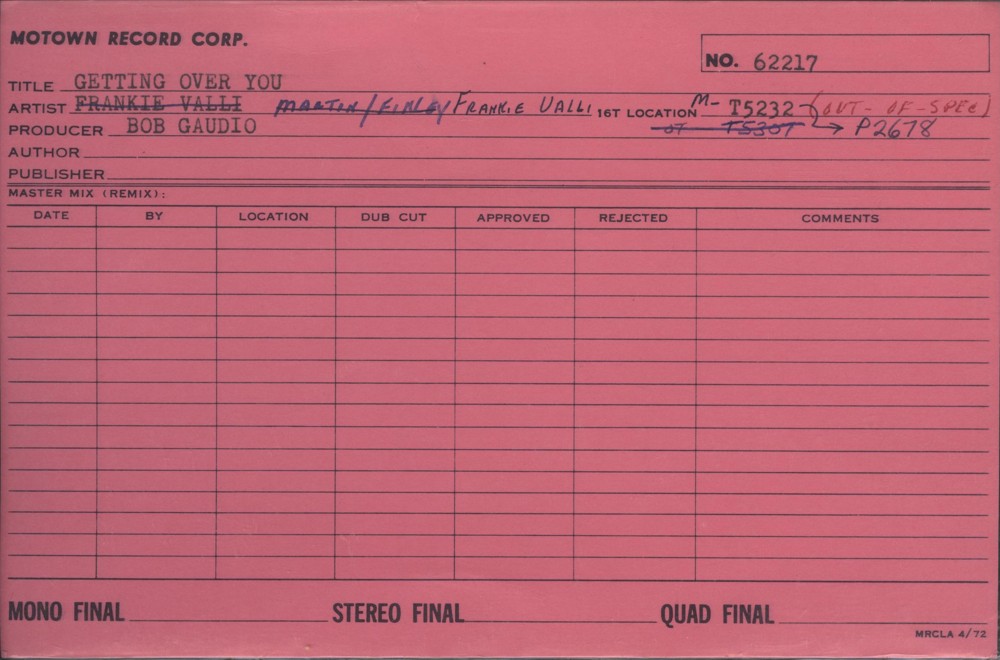 Artists Card FV002 — view scan
For reasons unknown, Bob Gaudio didn't select this one from his own sessions with Valli for the tracks sent for the Snapper box set. Still awaiting its release.
Session Block 7 — November–December 1973: Bob Crewe’s Last Motown Sessions
Media Sound, with the reformed line-up: Polci, Shapiro, Callas, Long, plus Nick Massi returning and Charles Calello arranging
Motown's final real commitment: a rebuilt group, with two new lead vocalists, recording new Crewe songs written with Kenny Nolan. Tape P2664 holds most of what came out of it — six masters cut over the same few weeks in November–December 1973. The sessions themselves ran November–December 1973.
Hickory
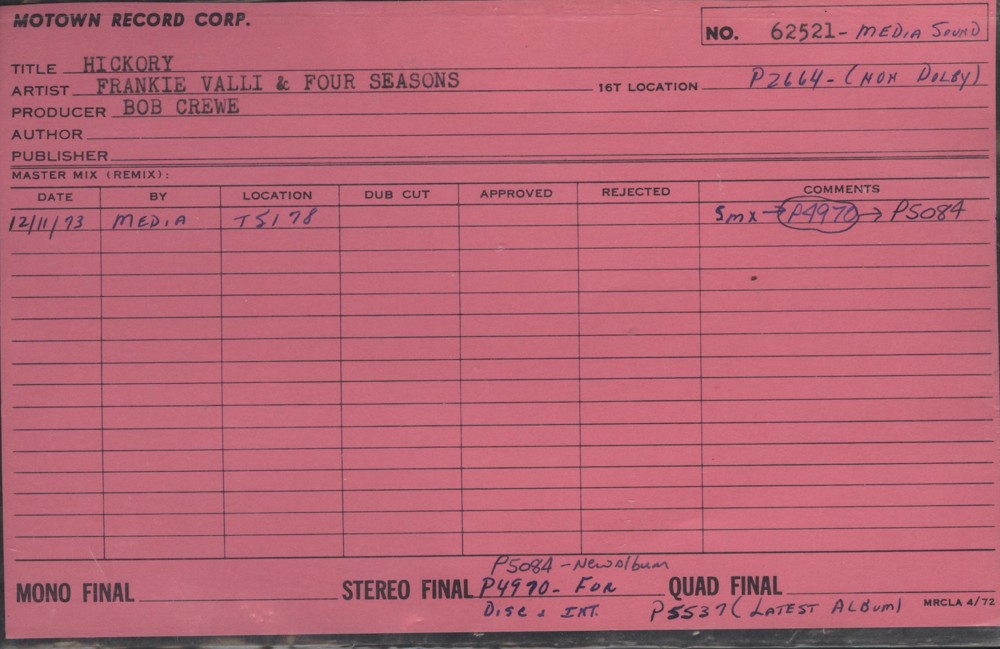 Artists Card FS003 — view scan
Issued as a non-LP single, Motown 1288 A, February 1974, and also included on the Inside You LP. An extended version beyond the released 45 has been found on acetate and can be heard here.
Hymn To Her (When My Love Touches Me)
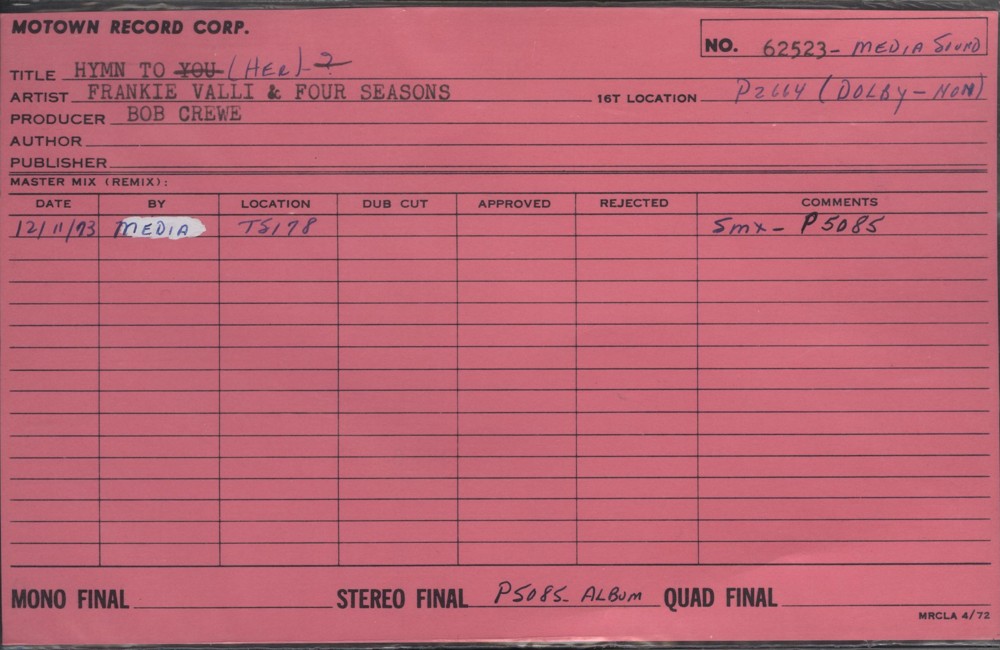 Artists Card FS003 — view scan
Mixed again in May 1974 for the second planned album, cancelled amid the group's conflict with Motown over lack of releases and promotion — understandable, given Motown had also failed to issue “My Eyes Adored You.” Salvaged on acetate and shared publicly in 2011 alongside “Lovers” — the discovery, described in the short intro above, that first proved the Tape Index was real. The Master Track Adviser noted that the mixes he found in the FSP's LA storage didn't quite match the arrangements of what the Motown Vault Manager was able to source for the approved 2023 box set and one of the alternate mixes was the 2011 acetate mix, with its fade into a church-choir sound, is arguably the definitive version.
Lovers
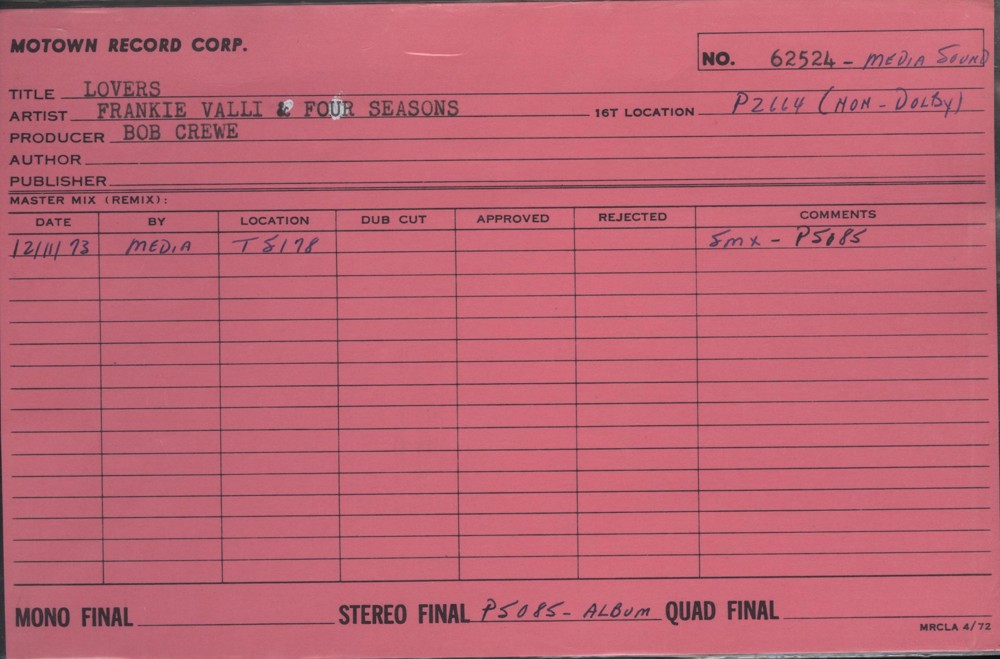 Artists Card FS004 — view scan
Same story as “Hymn To Her” — recorded and mixed alongside it, salvaged on the same 2011 acetate, mixed again in May 1974 for the cancelled album, and again a case where the FSP-storage find outperformed the mix sourced for the 2023 release. The alternate bonus-track mix has a ‘stepped’ ending that lifts the close of the track.
Charisma
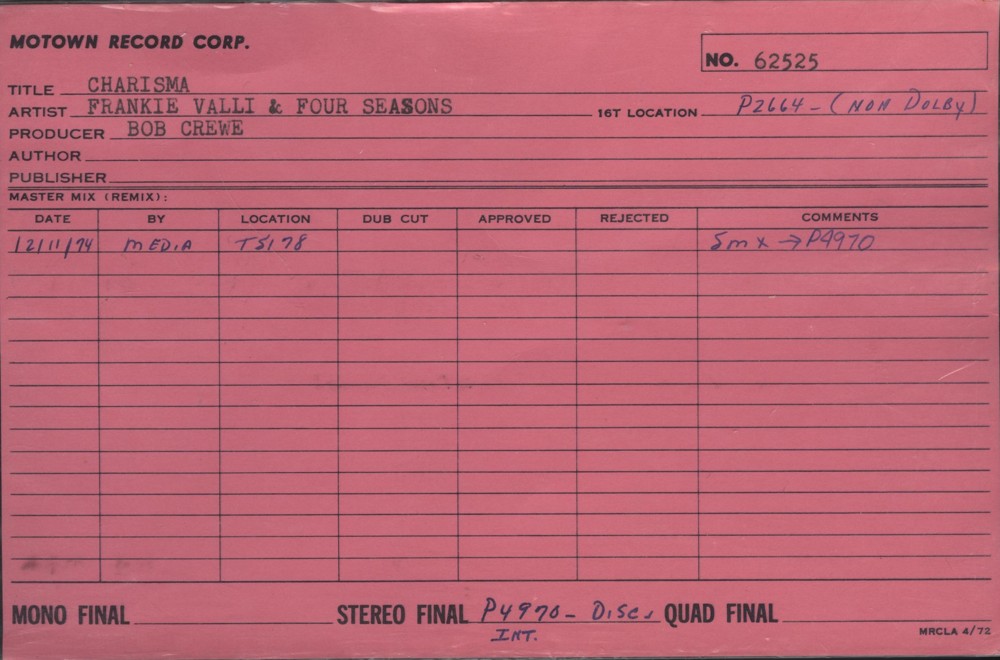 Artists Card FS002 — view scan
The edited version was issued as the B-side of “Hickory,” Motown 1288F B, February 1974, and included on the UK version of Inside You — and, oddly, on the 2008 Anthology CD too, despite that set's billing as released-material only, Bob Gaudio didn't select it for the Snapper box set. The unedited version was never issued on vinyl at all; the best mix by some distance is arguably Bob Crewe's own 2011 acetate (mono only), its heavy reverb on the outro harmonies and focus on Frankie Valli's falsetto reaching the ‘spiritual’ quality the title aimed for.
(You Gotta Make Your) Tomorrow Tonight
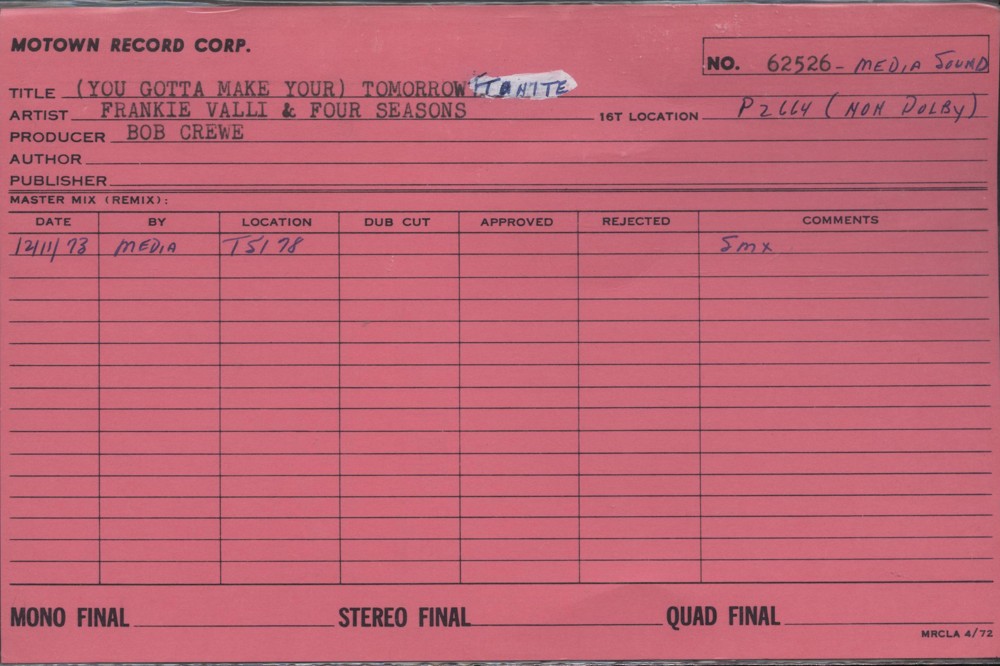 Artists Card FS010 — view scan
A joking, semi-parody mix reviving the sound of the Wonder Who — the group's own joke persona from nine years earlier. One of the four tracks found on the 2011 Bob Crewe acetate. There may even be a separate, ‘straight’ Four Seasons version with Frankie in his normal voice on the same tape.
My Eyes Adored You
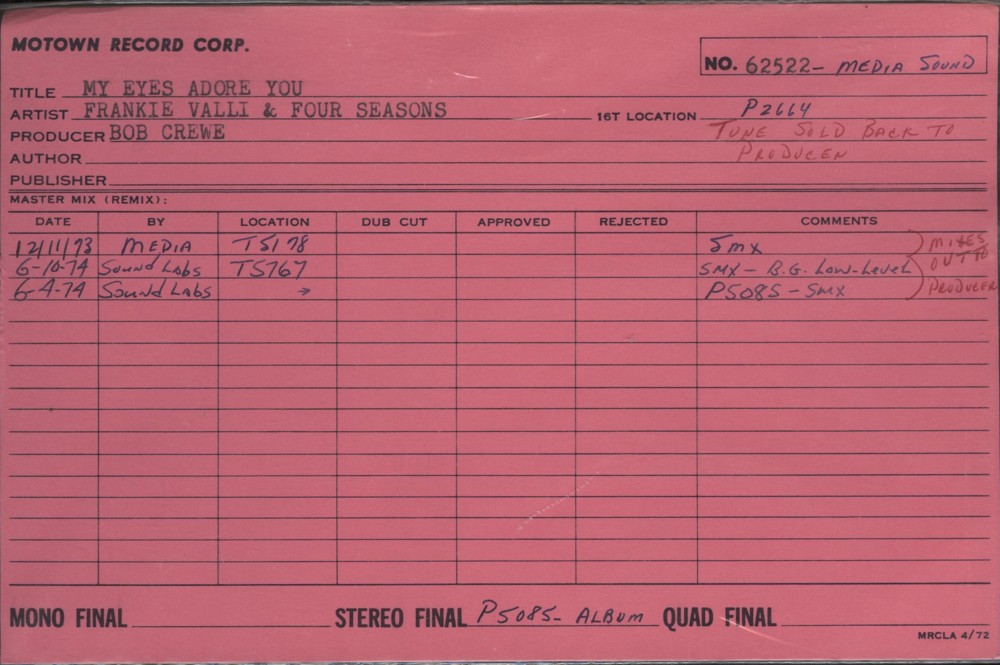 Artists Card FS006 — view scan
The full story of this master — and why it never came out on Motown at all — is the Later Life note directly below.
Nasty
Recorded by Eleventh Hour in 1974 from a Crewe-Nolan song; the tape guess for a Four Seasons/Valli cut points to this same P2664 reel.
Bob Crewe negotiated to buy the master outright as the group prepared to leave the label — the chain of custody the Artists Card records (see above) as “mixes out to producer,” then “tune sold back to producer.” The Motown/MoWest version, the one your own research found in the Four Seasons Partnership's LA storage, was not a rough or unfinished take — it had a more guitar-strong backing than the sweetened, strings-heavy sound Charles Calello later built for the Private Stock release. And critically, it isn't simply a different mix of the same vocal: Frankie Valli re-sang the vocal over the backing track on the 16-track master Bob Crewe had bought, a new performance laid down over the original instrumental rather than a remix of the take already on tape — the clearest proof of that being a different vocal ending from the familiar Private Stock version, something a simple remix could never produce. The version everyone knows from the radio is still Calello's 1975 rebuild with Crewe for Private Stock, which became the group's biggest US hit in a decade.
Session Block 8 — 1974–1975: The Label Relationship Collapses
Motown's Jobete publishing deal lapsing; the group departs for Warner-Curb and Private Stock
By 1974 both Crewe and Gaudio were writing under their own steam again, waiting out the end of their Motown/Jobete contracts, and no further new sessions were booked. What happened next to the material already on tape belongs here rather than to any one session: two attempts at assembling a shelved album (Sessions 5 and 7's leftovers, see Albums & Lost Albums), and then, once the group had gone, Motown's own decision in 1975 to finally release what it had. Once the Motown contracts lapsed, Crewe's writing with Kenny Nolan delivered the No. 1 hit they'd been chasing since 1971 — “My Eyes Adored You,” rebuilt at Private Stock, not on the Motown master above — and Bob Gaudio, now writing with Judy Parker, produced “Who Loves You” and “December, 1963 (Oh, What a Night)” for the New Four Seasons era that followed. The MoWest/Motown years — nearly four years between first session and the belated Inside You release, dozens of completed masters, only a handful released at the time — we end here.
Albums & Lost Albums
Five distinct album projects run underneath the sessions above — one released on schedule, one released four years late (with an unplanned US/UK chart afterlife of its own), and three that never came out at all.
Bob Gaudio's twelve-track self-contained album, built from the October 1971–February 1972 sessions in Block 1. Produced by Gaudio, arranged by Dave Blumberg, Charles Calello and Joe Scott, mixed by Russ Terrana. Two singles came from it (“Love Isn't Here” and “Walk On, Don't Look Back”) plus one cancelled pairing (“The Night” b/w “Sun Country”). The planned UK single of the same song went on to take the UK charts by storm in 1975 — prompting the album's own UK re-release that year.
At the start of the FSP contract it is clear that it would include a Frankie Valli ‘solo’ album. One was given a Mowest 114L number, but it was cancelled in June 1972. It is a separate project from the later “Inside Out” album below, though some of the tracks may have surfaced on the 1975 “Inside You” album.
A second group album was assembled and given a provisional Motown catalogue number, MW788, before being shelved — the follow-up to Chameleon _Motown lost confidence in after “How Come” underperformed in spring 1973. The same tape also carries transferred copies of “How Come” (original EQ, Dolby) and “Life and Breath,” suggesting it was assembled as a working draft of the running order rather than a final master. This is the album the Block 5 narrative above refers to as shelved “weeks before its release.”
A ‘Untitled’second attempt at a shelved album, compiled from material spanning nearly the whole Motown period: “The Night,” “Sun Country,” “Touch The Rainchild” (all Chameleon-era, Block 1), “Inside You” (Take 20, Block 4), “You Can't Hold On” and “Whatever You Want” (Block 6), “Love Isn't Here” (Block 1), and “Hymn To Her,” “Lovers,” “Hickory” and “My Eyes Adored You” (all Block 7). It was never released at the time — this compiled running order is effectively a snapshot of the best material left in the vault as the group's Motown contract wound down.
The album that finally emerged, a year after the group had left the label. Russ Terrana was instructed to pull an album together to compete with the group's own new hit for Warner-Curb, “Who Loves You,” and gathered tracks from across the whole Motown period — some over three years old, several never released — to do it. He added reverb and echo across several of them, distorting the harder ‘rock’ sound Crewe and Gaudio had originally aimed for; “With My Eyes Wide Open” (Later Life note, Block 4) is the clearest example. Mixed and mastered by Russ Terrana at Motown Recording Studios, Hollywood; production coordination by Suzee Wendy Ikeda; art direction by Frank Mulvey. The UK Tamla Motown pressing, MW7007, carries additional bonus tracks not on the US LP, including “The Scalawag Song” and the edited “Charisma.”
Unconfirmed / Title-Only
These titles appear in the Tape Index with no surviving tape location, date, or producer credit — nothing to place them against a session with any confidence. Left here, unchanged, for you to match against the spreadsheet if you recognise them.
Excluded Anomalies
Post-script
This section has cross-checked every master number in this draft against the Official Universal Motown Masters List (March 2016) and, this pass, against the physical Artists Cards themselves. Two open items remain, flagged in place above rather than silently resolved: “I Can't Get Away From You” (master 61588) is credited on the Masters List to Bob Crewe, not Michael Masser as this draft has it, with no Artists Card surviving to settle it either way; and “Inside You” (master 61758 in the Masters List and Tape Index) is typed as 61748 on its own Artists Card, a straight conflict between the two primary sources with nothing else to arbitrate it. Neither is it an exact science — these records were kept by hand, decades apart, by different people, and reading them now is itself an act of interpretation. Bob Gaudio, or the Vault Manager, likely knows more than any paper trail can settle. Until one of them speaks of it, any anomalies and both numbers queries are recorded here as our best current reading of the surviving evidence, not as a final answer.
This project owes its foundation to three people. Keith Hughes found and shared the Artists Cards themselves — kept on microfiche in Universal Motown’s own archive — without which this cross-reference would not exist. Andy Skurow, Vault Services Manager at Universal Motown, carried out the physical search of the tape vaults that confirmed much of what the paper record alone could not. And Paul Nixon championed the case for releasing these tracks directly with then-CEO Harry Weinger, who was himself a long-standing advocate for issuing unreleased material wherever the CD era allowed it — a format now itself increasingly rare, as younger listeners turn their own research and collecting instincts toward vinyl instead.
It is also worth recording, for whoever reads this next, that Universal Motown’s own offices may hold further records beyond what is captured here — computer-held data this project has not had access to. Bob Gaudio, seeing the full extent of what this record shows still exists on tape, may find good reason of his own to press Universal Motown further and account for anything still missing from his side. That pursuit continues: we will keep seeking his approval to release as many of the remaining unreleased tracks as possible.